
Lost Dog Prevention:
Microchips, ID Tags, and GPS Trackers
Your complete guide to lost dog prevention: the three layers of protection that bring lost dogs home.
You’re heading out for a walk. The leash is in your hand, your dog is wagging at the door, and everything feels routine. You don’t think about your dog bolting after a squirrel. You don’t expect a loud car backfire to send them sprinting down the street. It’s just a normal day.
But here’s the reality: dogs go missing every single day. Not because their owners are careless, but because life happens. A gate left unlatched. A poorly fitted collar that slips off. A sudden fear response that overrides years of training.
According to the American Veterinary Medical Association (AVMA), roughly 10 million pets go missing in the United States every year. That’s not a rare tragedy—it’s a daily occurrence happening in neighborhoods just like yours.
Here’s another number that matters: dogs with microchips are returned to their owners at a rate of about 52%, compared to just 22% for dogs without microchips. That 30-point difference represents thousands of reunions that wouldn’t have happened otherwise.
The good news? Most lost dog prevention situations are preventable. And if they do happen, the right preparation dramatically increases your odds of a happy ending.
I’m not a veterinarian or a professional trainer. I’m just someone who has spent time reading case reports, talking to shelters, and learning from experts—so you don’t have to learn these lessons the hard way. This guide covers the three layers of lost dog prevention and how to make them work together.
What's in This Guide
In this guide, I’ll walk you through:
-
Part 1: Why Dogs Get Lost — and the Numbers That Matter
-
Part 2: The Microchip — Your Dog’s Permanent ID
-
Part 3: ID Tags — The Visible Lifeline
-
Part 4: GPS Trackers — Real-Time Location Technology
-
Part 5: How the Three Layers Work Together
-
Part 6: Daily Prevention Habits
-
Lost Dog Prevention Checklist
-
FAQ
-
What’s Ahead in This Series
The bottom line: Lost dog prevention isn’t about one thing—it’s about layering three: a microchip, an ID tag, and a GPS tracker. Together, they cover almost every failure point.
Let’s get started.
Part 1
Why Dogs Get Lost: The Numbers That Matter
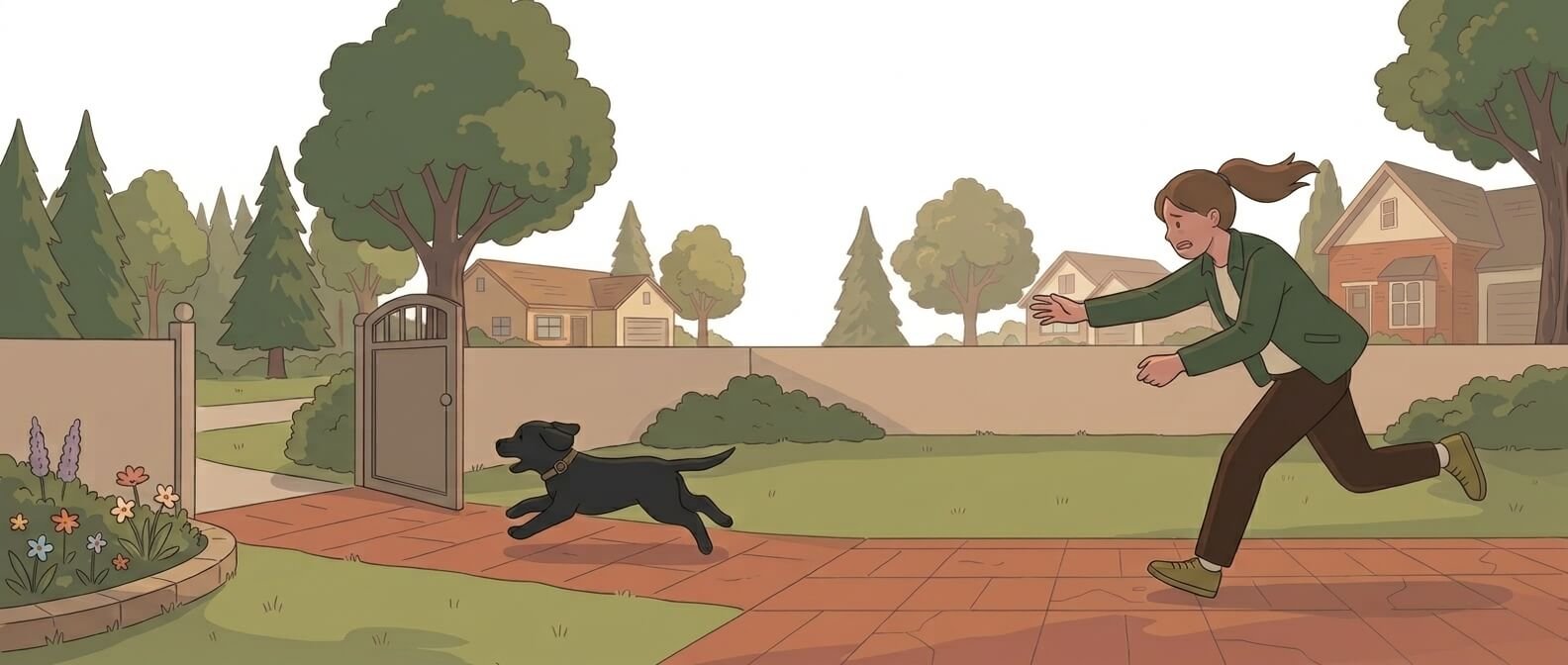
It's easy to assume a lost dog only happens to inattentive owners. The truth is, it can happen to anyone. A dog that has never bolted in ten years can suddenly take off after a deer. A normally calm dog can spook at a firework and slip through a half-open door.
According to the Humane Society, most lost dogs are found within a mile of home—but only if they have proper identification. That's why lost dog prevention starts long before your dog ever slips out the door.
Most Common Lost Dog Scenarios
I’ve talked to too many owners who thought it couldn’t happen to them. Then it did. Here are the most common scenarios:
-
Sudden noise or fright: Fireworks, thunderstorms, construction sounds, or even a dropped object can trigger a fear response that overrides training.
-
Chasing prey: Squirrels, rabbits, deer—dogs are wired to chase. When instinct kicks in, recall goes out the window.
-
Open doors or gates: It only takes a second. A delivery person, a visitor, or even your own hands full of groceries can create an escape route.
-
Leash or collar failure: A snapped leash, a broken buckle, or a collar that slips over the head can leave your dog loose in an instant.
-
Dog theft: It’s a hard reality, but pet theft is also a concern. AKC Reunite reports that dog thefts in the U.S. are up 34% over the last five years.
These scenarios are common, predictable, and largely preventable. The three layers we’re about to cover are designed to address each one.
Quick Answer: Dogs get lost for five common reasons: sudden noise or fright (fireworks, thunderstorms), chasing prey, open doors or gates, leash or collar failure, and dog theft. Most of these are predictable and preventable. The three layers of lost dog prevention—a microchip, an ID tag, and a GPS tracker—are designed to address each one.
Part 2
The Microchip: Your Dog's Permanent ID
Think of a microchip as your dog's permanent ID card—one that can't fall off, get chewed up, or fade with time. It's the foundation of any lost dog prevention plan.
What a Microchip Is and How It Works
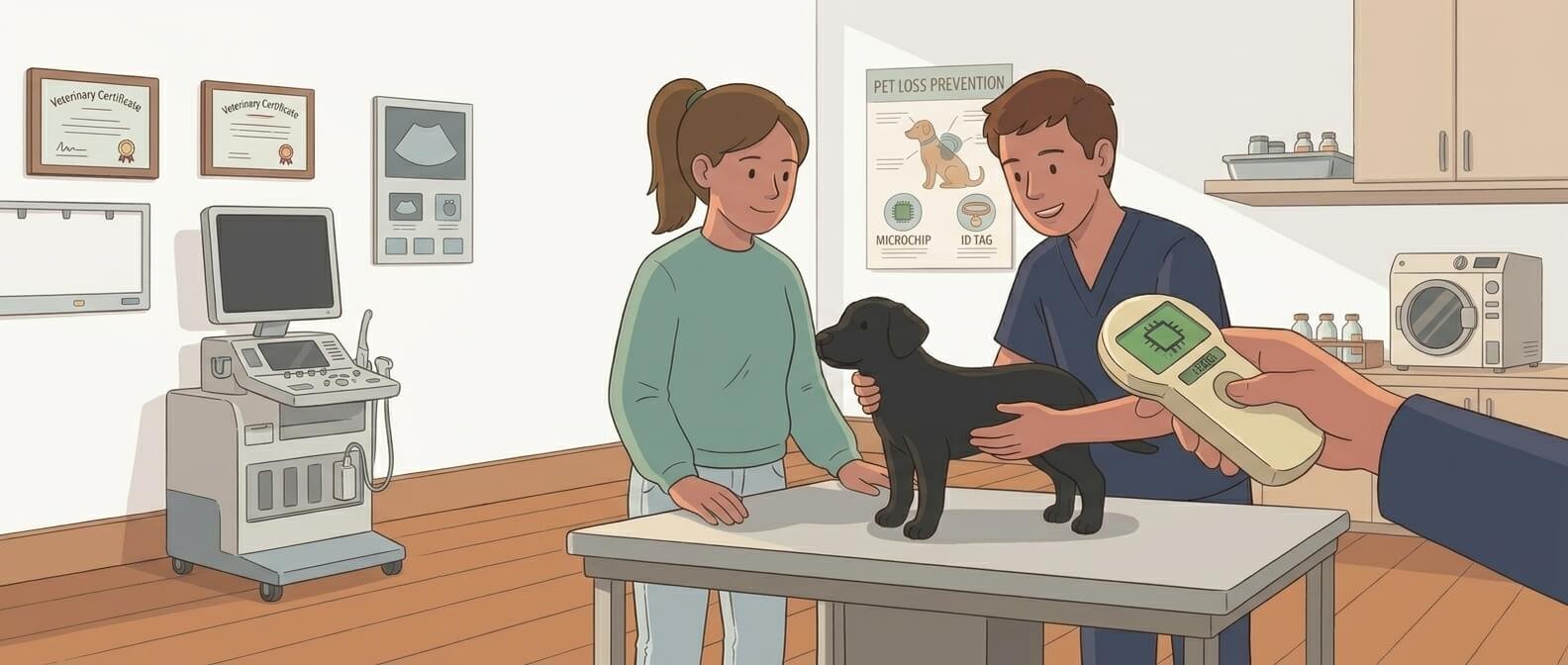
A microchip is a tiny transponder about the size of a grain of rice. It’s made of biocompatible glass (safe for the body) and contains a unique identification number. The chip itself has no battery and no moving parts. It sits passively under your dog’s skin until a scanner passes over it, emitting a low-frequency radio wave that reads that unique ID number.
The procedure is quick and simple. Your vet or a trained technician injects the chip under the loose skin between your dog’s shoulder blades using a syringe-like applicator. The whole thing takes about 10 seconds or less, and most dogs show minimal reaction.
The Critical Step: Registration
Here’s the part that trips up too many dog owners: the chip itself doesn’t do anything until you register your contact information in a database.
If your dog’s microchip ID number isn’t linked to your current phone number and address, that chip might as well not exist. I’ve heard heartbreaking stories of dogs brought to shelters, scanned, and found to have chips—only to discover the owner’s phone number was disconnected or the address was three moves ago.
Keep your registration up to date every time you move, change phone numbers, or even adopt a dog from someone else. Most registries charge a small fee to update information, but it’s one of the best investments you’ll ever make.
ISO Standard Microchips
If you travel internationally with your dog, look for an ISO-standard microchip (operating at 134.2 kHz). These chips follow international standards (ISO 11784 and 11785) and are readable by scanners worldwide. Some older chips use different frequencies (like 125 kHz AVID chips) that may not be read by scanners in other countries. Most reputable vets now use ISO-compliant chips, but it’s worth asking to be sure—especially if you travel internationally.
See the AAHA’s microchip guidelines for more.
Quick Answer: A microchip is a tiny transponder—about the size of a grain of rice—that sits under your dog’s skin and stores a unique ID number. But the chip itself doesn’t do anything until you register your contact information in a database. Keep your registration up to date every time you move, change phone numbers, or adopt a dog. If you travel internationally, ask for an ISO-standard microchip (134.2 kHz).
Part 3
ID Tags: The Visible Lifeline
A microchip is essential, but it only works after someone finds your dog and brings them somewhere with a scanner. ID tags work the second a person lays eyes on your dog.

What Information Should Go on a Tag?
Your dog’s ID tag should answer one question: Who do I call to get this dog home?
Here’s what I recommend including:
-
Your primary phone number—the one you actually answer
-
A backup phone number—partner, family member, or close friend
-
Your city and region—enough to give context (city + state in the U.S., or city + country elsewhere)
-
“I’m chipped”—a simple note to remind finders to get the dog scanned
One important note: I don’t recommend putting your dog’s name on the tag. It doesn’t help anyone contact you faster, and it gives strangers familiarity with your dog—which can be a subtle risk if someone with ill intentions finds them.
Engraved Tags vs. QR Code Tags
Here’s a choice that’s become more relevant in recent years. Traditional engraved tags are simple and durable. QR code tags let you store a much richer profile and get notified the moment someone scans them.
Feature | Engraved Tag | QR Code Tag |
|---|---|---|
Information capacity | ~40 characters per side | Unlimited, online profile |
Update when info changes | Must engrave a new tag | Update instantly from your phone |
Notifies owner when scanned | No | Yes, with GPS location of finder |
Works without a smartphone | Yes | No |
Cost | $8–$25 one-time | $20–$60/year subscription |
Requires subscription | No | Usually yes |
The best solution? Use both. A small engraved tag with your number provides a reliable fallback, and a QR tag adds modern features like instant notifications.
Collar Safety: Breakaway vs. Flat Collars
The tag is only useful if the collar stays on. But collars come with their own safety trade-offs.
-
Flat collars (standard buckle or snap collars) are secure and won’t release accidentally. They’re a good choice for walks and outings when you’re supervising.
-
Breakaway collars are designed to snap open if they catch on something—a branch, a fence, or another dog’s teeth. This can prevent choking or strangulation, especially for dogs who roam unsupervised.
Many owners choose a breakaway collar for everyday wear and switch to a flat collar for walks. Whichever you choose, check the fit regularly.
For more on collar safety, see the Humane Society’s guide to collars and tags.
Quick Answer: An ID tag should include your primary phone number, a backup number, your city and region, and “I’m chipped” to remind finders to scan for a microchip. Don’t put your dog’s name on the tag—it doesn’t help contact you faster. Choose between engraved tags (simple, durable, no subscription) and QR code tags (more info, instant notifications, subscription required). Many owners use both. And check your collar fit regularly.
Part 4
GPS Trackers: Real-Time Location Technology
If a microchip helps bring your dog home after someone finds them, a GPS tracker helps you find them before someone else does. It's the newest layer in lost dog prevention, and it's been a game-changer for many owners.
How GPS Trackers Work
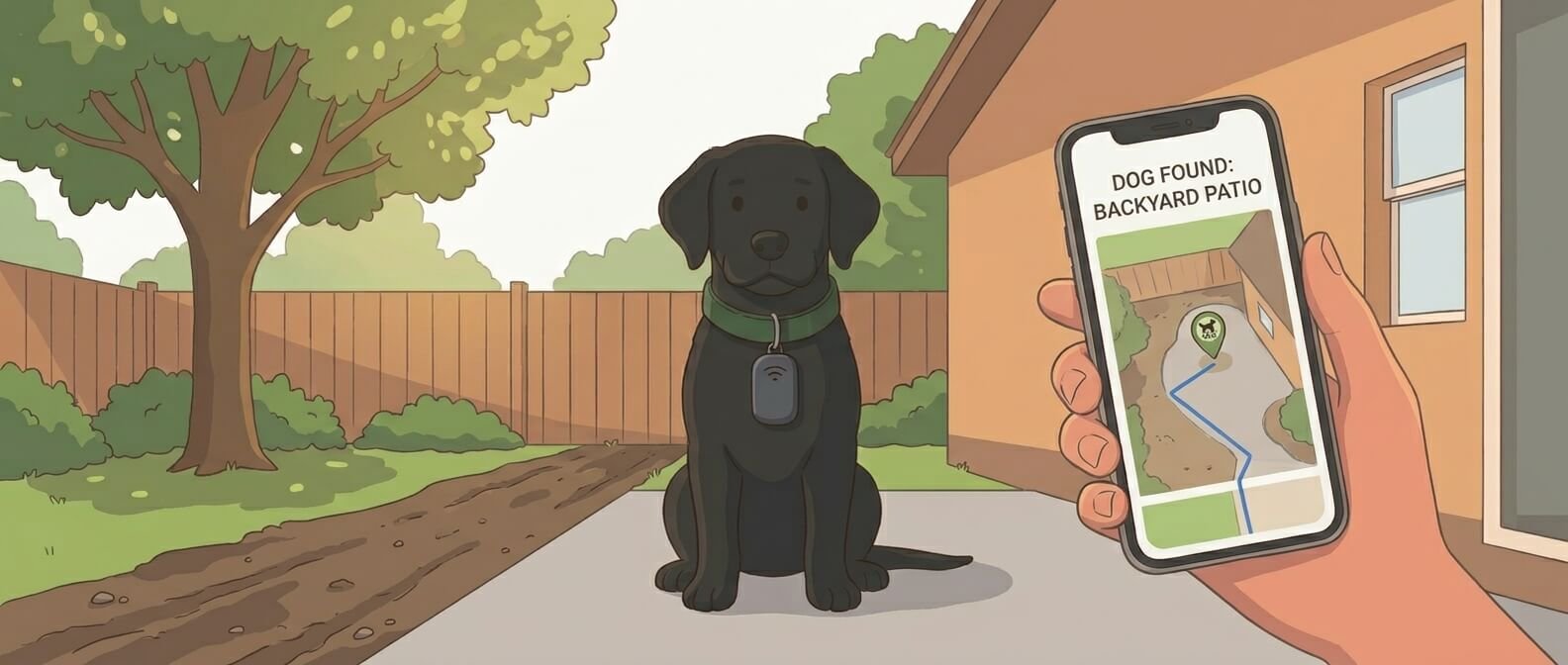
A GPS dog tracker uses a combination of:
-
GPS satellites to determine your dog’s location
-
Cellular networks (like LTE-M) to transmit that location to your phone
-
Bluetooth for close-range finding (like Apple’s Find My network)
The tracker clips onto your dog’s collar (or is built into the collar itself) and communicates with an app on your phone. You can see your dog’s location on a map, set virtual fence boundaries, and receive alerts if they wander beyond a safe zone.
Key GPS Tracker Brands Compared
Based on real-world testing and network reliability, three brands consistently stand out in the GPS tracker space: Tractive, Fi, and Whistle.
Brand | Best For | Hardware Style | Battery Life | Tracking Focus |
|---|---|---|---|---|
Tractive | Most buyers; live GPS tracking | Clip-on tracker | 2–7 days (Live mode drains faster) | Live location, virtual fences, escape alerts |
Fi Smart Collar | Active dogs; integrated smart collar experience | Collar-integrated tracker | Several weeks (months on Wi-Fi; 1–2 days in Live mode) | Location, activity, sleep, behavior trends |
Whistle | Legacy research (older models) | Clip-on tracker | Varies by model | Historically GPS + health monitoring |
Tractive is often the easiest starting point. It clips to any collar, offers live tracking and virtual fences, and balances cost with reliable performance. Fi appeals to owners who want a sleek, collar-integrated system with strong battery life and activity tracking.
For more on GPS trackers for dogs, see the AKC’s guide to GPS dog trackers.
What About Apple AirTag?
You might be wondering about AirTags as a cheaper alternative. It’s a fair question.
An AirTag uses Apple’s Find My network, which relies on nearby Apple devices to detect and report the AirTag’s location. In dense urban areas, that works reasonably well. But in rural areas, on hiking trails, or anywhere with fewer people, an AirTag might not update for hours or at all.
AirTags are not real-time GPS trackers. They can be a helpful backup or a lightweight option for low-risk outings, but they don’t provide the live tracking and escape alerts you’ll get from a dedicated GPS tracker.
Quick Answer: GPS trackers use satellites, cellular networks, and Bluetooth to show your dog’s real-time location on your phone. Three brands stand out: Tractive (best for most buyers), Fi (collar-integrated), and Whistle (legacy). Apple AirTags are not real-time GPS trackers—they rely on nearby Apple devices, so they may not update for hours in rural areas. For real-time tracking and escape alerts, use a dedicated GPS tracker.
Part 5
How the Three Layers Work Together
Let me be clear about something: These three tools are not alternatives. They are complementary. That's the core principle of lost dog prevention.
The Three Layers at a Glance
Layer | When It Works | Why You Still Need the Others |
|---|---|---|
ID Tag | The moment someone finds your dog | Can fall off or be removed; doesn't help if no one is nearby |
Microchip | When the finder takes your dog to a vet or shelter | Requires a scanner; the finder has to make the effort |
GPS Tracker | Before the dog is found, while they're still moving | Can lose battery or signal; doesn't identify the dog to a finder |
Here’s the strategy I recommend:
-
Keep a well-fitted collar with visible ID tags on your dog during walks and outings. That’s the quickest path to a phone call.
-
Ensure your dog is microchipped and the registration is current. That’s your backup plan if the tags are lost or removed.
-
Consider a GPS tracker for high-risk situations—hiking in unfamiliar areas, dogs with unreliable recall, or if you live in a busy urban area with lots of roads.
A well-designed system uses all three. You don’t want to rely on one layer alone. For more on finding a lost dog, see the Humane Society’s lost pet resources.
Quick Answer: The three layers of lost dog prevention are not alternatives—they’re complementary. An ID tag works the moment someone sees your dog. A microchip works when someone takes your dog to a vet or shelter. A GPS tracker works before anyone finds them, while they’re still moving. Each one covers a different failure point. Use all three: a well-fitted collar with ID tags, a registered microchip, and a GPS tracker for high-risk situations.
Part 6
Daily Prevention Habits
Prevention isn't just about gear. It's about habits. These daily practices will help keep your dog safe before any of the three layers ever need to kick in. That's what lost dog prevention really looks like.
Pre-Walk Equipment Checks
Before every walk, take 30 seconds to check:
-
Is the collar fitted correctly? You should be able to slip two fingers under it, but not pull it over the dog’s head.
-
Are the clips and rings in good condition? Check for rust, cracks, or wear on buckles and D-rings.
-
Does the harness (if you use one) sit properly? Check that it’s not twisted and fits securely without chafing.
-
Is the leash in good shape? Look for fraying or weak spots, especially near connections.
-
Is your dog attached before doors open? Make it a rule—leash on before the door opens.
The Recall Command
A reliable recall is the single most useful safety skill your dog can learn. It’s the command that can call them back from a squirrel, an open gate, or a dangerous situation.
This is a big enough topic that I’ll cover it in depth later in this series: How to Train a Dog Recall: The Most Important Safety Command. For now, start by practicing recall in low-distraction environments with high-value treats. Make coming to you the best part of your dog’s day.
Keep Recent Photos Handy
If your dog ever goes missing, you’ll need a recent, clear photo for lost dog posters and social media posts. Take a few good shots of your dog from different angles every few months. Include a photo that clearly shows their face, body type, and any distinctive markings. Save these somewhere you can access quickly—your phone, cloud storage, or both.
Pro tip: Also save a photo of your dog with you (or a family member) in the frame. This can help prove ownership if someone finds your dog and questions whether they’re yours.
For more on what to do if your dog goes missing, see the Humane Society’s lost pet resources.
Quick Answer: Daily prevention habits matter as much as gear. Before every walk, check your dog’s collar fit, clips, harness, and leash. Train a reliable recall—it’s the single most useful safety skill your dog can learn. And keep recent, clear photos of your dog handy for lost dog posters and social media. These habits are what make lost dog prevention work in real life.
FAQ: Lost Dog Prevention
Microchipped dogs are returned to their owners at a rate of about 52%, compared to just 22% for dogs without microchips. That's a 30-point difference. But microchips only work if the registration is current—so update it every time you move or change phone numbers.
Yes. A microchip only works if someone takes your dog to a vet or shelter with a scanner. An ID tag works the moment someone sees your dog—no scanner needed. You need both.
It depends on your needs. Tractive is the easiest starting point for most buyers (clip-on, live tracking, virtual fences). Fi is best for owners who want a collar-integrated system with activity tracking. Whistle is a legacy option with health monitoring. See our Microchip vs GPS Tracker guide for a full comparison.
No. AirTags rely on nearby Apple devices to report their location—so they may not update for hours in rural areas or on hiking trails. They're a helpful backup, but not a real-time GPS tracker. For live tracking and escape alerts, use a dedicated GPS tracker.
Log in to the registry where you originally registered the chip (or use the registry's website/app). Update your phone number, address, and any other contact details. Most registries charge a small fee. Do this every time you move or change phone numbers.
No. Your dog's name doesn't help anyone contact you faster—and it gives strangers familiarity with your dog, which can be a subtle risk. Instead, put your phone number, a backup number, and your city/region.
A flat collar is secure and won't release accidentally—good for walks and outings. A breakaway collar snaps open if it catches on something (a branch, a fence, another dog's teeth), which prevents choking. Many owners use a breakaway collar for everyday wear and a flat collar for walks.
The procedure takes about 10 seconds or less. Your vet or a trained technician injects the chip under the loose skin between your dog's shoulder blades. Most dogs show minimal reaction.
Most GPS trackers require a subscription (usually $5–$15/month) because they use cellular networks to transmit location data. Some Bluetooth-only trackers don't require a subscription, but they only work within a short range (30–100 feet). For real-time tracking, a subscription is usually necessary.
Don't panic—and don't wait. Start by searching the immediate area, then post on local lost-pet groups, call local shelters, and check your GPS tracker app if you have one. See our emergency plan for a step-by-step guide.
The Ultimate Lost Dog Prevention Checklist
Before every walk or outing:
-
☐ Collar fits properly (two fingers, not slipping over head).
-
☐ ID tags are attached and legible.
-
☐ Leash is in good condition with secure clips.
-
☐ GPS tracker is charged and attached (if using one).
-
☐ Leash is on before the door opens.
At least once a year:
-
☐ Update microchip registration (check phone number and address).
-
☐ Check ID tag for wear; replace if numbers are fading.
-
☐ Take fresh photos of your dog from multiple angles.
-
☐ Practice recall in a safe, enclosed space.
If you’re traveling or in a high-risk area:
-
☐ Write down your current temporary contact info on a tag or marker.
-
☐ Check GPS tracker battery and cell coverage in the area.
-
☐ Carry a printed photo of your dog in case you need it quickly.
The bottom line: This checklist takes 30 seconds. It can be the difference between a lost dog and a found one.
A Final Thought
Lost dogs happen to good owners. It’s not about being careless—it’s about being prepared. The three layers we covered—microchip, ID tag, and GPS tracker—each serve a different purpose. They’re not replacements for one another. They’re a team.
Microchips are your permanent backup. They work even when everything else fails. ID tags are your first responder. They get the call made faster than anything else. GPS trackers are your search party. They help you find your dog before someone else does.
One layer is better than none. Two is better than one. All three give you the best possible chance of bringing your dog home. That’s what lost dog prevention really comes down to.
I learned these lessons through research, not experience. Please learn them too—your dog is counting on you. That’s what lost dog safety is really about.
More in This Series
This guide covered the big picture. Now dive deeper into specific risks.
Dog Microchip vs GPS Tracker: Which One Does Your Pup Need? — A head-to-head comparison to help you choose.
What to Do If Your Dog Gets Lost: Step-by-Step Emergency Plan — Your action plan for the first hour and beyond.
Breakaway Collar vs Flat Collar for Dogs: Safety Trade-Offs Explained — Which collar is right for your dog’s lifestyle?
How to Train a Dog Recall: The Most Important Safety Command — Practical steps to build a recall you can count on.
All part of the Lost Dog Prevention module here on OutdoorDogSafety.com.
Disclaimer: This content is for informational purposes only and does not constitute veterinary or professional safety advice. Always consult with a qualified veterinarian or professional dog trainer regarding your dog’s specific needs and safety considerations.