
Frequently Asked Questions
Quick answers to the most common questions about keeping your dog safe outdoors from walking safety to wildlife encounters.
We get it — taking your dog outside should be the best part of your day. And honestly? It usually is.
But let’s be real for a second. Between hot pavement, busy streets, random wildlife, and that one trail that looked way easier on the app… there’s stuff we don’t always think about until it happens.
That’s where outdoor dog safety comes in.
At OutdoorDogSafety, we’re just dog people like you. Everything here is free to read, written by fellow owners who’ve been there, and updated regularly as we learn more. We’re not vets — just experienced dog lovers sharing what’s actually worked for us (and what hasn’t).
We’ve made the mistakes, asked the dumb questions, and learned the hard way so you don’t have to. This FAQ is packed with real-world answers to the stuff we actually worry about when we’re out there with our pups.
Got a specific question? Skip around. Read what you need. And if you don’t find what you’re looking for, hit us up — we’re here.
General Outdoor Dog Safety
Honestly? Think ahead.
Before you step out the door, just take a second. Check the weather, think about your route, consider your dog’s energy level, and ask yourself: is there anything sketchy out there today?
Keep your dog’s ID up to date, use gear that actually fits, bring water when it’s warm, and pay attention to how your dog is acting. A little prep work goes a long way — and most outdoor accidents are totally preventable.
There’s a bunch, and some of them aren’t obvious until you’re right in the middle of it. Here are the usual suspects:
Cars and traffic (this is the big one)
Hot pavement that burns paws
Broken glass, sharp sticks, trash
Toxic plants and mushrooms
Lawn chemicals and pesticides
Stagnant water or algae blooms
Wildlife (coyotes, snakes, even aggressive off-leash dogs)
Steep or rocky terrain
Loose collars or harnesses that let a dog slip out
Getting lost
The risks change depending on where you live and what you’re doing, but knowing what to look for is half the battle.
Not always — but check your local leash laws first.
If you’re on a busy street, an unfamiliar trail, or anywhere near wildlife, keeping your dog leashed is just smarter. Even the best-behaved dog can suddenly bolt after a squirrel or get spooked by a loud noise.
Off-leash is awesome when it’s safe. But a solid recall takes time to build, and not every dog is ready for that freedom yet.
Want to work on recall? Check out our guide: How to Train a Dog Recall: The Most Important Safety Command
For a regular neighborhood stroll, keep it simple:
A leash that doesn’t feel flimsy
A well-fitted collar or harness
ID tags (seriously, check them before you leave)
Poop bags (you know the drill)
Water if it’s warm out
For longer adventures, throw in:
Extra water + a collapsible bowl
Some snacks or treats
A tiny first-aid kit (bandages, tweezers, antiseptic wipes)
Your phone
Any meds your dog needs
A towel (mud happens)
Tick-check tools
A GPS tracker if your dog tends to wander
Pack for the adventure, not just the walk.
Watch your dog, not your watch.
If they’re panting harder than usual, slowing down, stumbling, drooling like crazy, or looking confused — that’s your sign to stop. Puppies, seniors, overweight dogs, and flat-faced breeds (like Bulldogs or Pugs) need extra breaks.
When in doubt, take a break. Find some shade, offer water, and let your dog catch their breath. They’ll tell you when they’re ready to move again.
100%.
Puppies are still learning how their bodies work. They don’t have the coordination or stamina for long hikes or hot pavement. Senior dogs might have bad joints, poor eyesight, or less tolerance for heat.
That doesn’t mean they can’t enjoy outside time — just adjust the pace, distance, and terrain to what they can handle. A short, slow sniffari can be just as fun as a 5-mile hike.
Walking & Road Safety
Keeping your dog safe near roads comes down to three things: position, control, and habits.
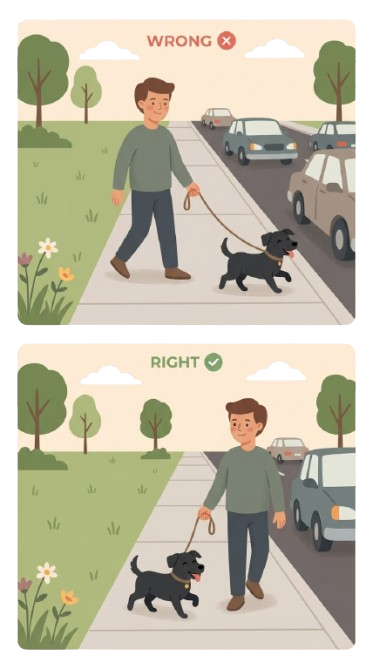
Always walk your dog on the inside of the sidewalk — you between them and the cars. Use a fixed-length leash (about 4–6 feet) so they can’t suddenly wander into the street. And teach them to stop and wait at every intersection, no exceptions.
Here’s the routine we use: approach the curb, ask for a “sit” or “wait,” look both ways (yes, like you learned in kindergarten), and only cross when you say it’s clear. Do it every single time, and it becomes second nature — for both of you.
If there’s no sidewalk, walk facing traffic so you can see cars coming, and keep your dog on the side away from the road.
More tips here: The Complete Dog Walking Safety Guide
We don’t recommend it near roads.
Retractable leashes give your dog too much freedom — up to 20+ feet of freedom. That means they can wander closer to traffic, other dogs, or cyclists before you even have time to react. The thin cord can also cause rope burns if it gets wrapped around your legs or your dog’s paws.
Save the retractable for open parks, beaches, or trails where there’s plenty of room. For street walks, a sturdy 4–6 foot fixed leash gives you way more control when it counts.
Leash recommendations: The Best Leashes for Road Walks: What to Use and What to Avoid
It depends on your dog.
A good harness takes pressure off the neck and gives you more control if your dog pulls. A collar works fine for calm walkers. But here’s the thing: whatever you use, make sure it fitsand your dog can’t slip out of it.
Two words: Be seen.
You and your dog should both be visible from a distance. That means:
Reflective vest or gear for you (not just dark clothes)
Light-up collar, LED leash, or clip-on lights for your dog
A flashlight or headlamp so you can see hazards (and so drivers can see you)
Stick to well-lit streets and avoid dark shortcuts. And keep your dog on a short leash — at night, you have less time to react to cars, cyclists, or unexpected animals.
More on this: Night Dog Walking Safety: How to Stay Visible and Avoid Hazards After Dark
First, don’t just yank them back — that teaches them nothing except that walks are stressful.
Instead, try this:
Stop walking the moment they pull. Don’t move forward until the leash goes slack.
Turn and walk the other way when they pull toward the road. It breaks their focus and teaches them that pulling doesn’t get them where they want to go.
Use high-value treats to reward them for walking calmly beside you near the curb.
It takes patience, but consistency wins. If your dog is a serious puller, a front-clip harnesscan give you more leverage without hurting their neck.
And practice away from traffic first — get the behavior solid in a quiet area before you test it on a busy street.
Scared dogs don’t need punishment — they need space and patience.
If your dog freaks out near traffic, here’s what helps:
Create distance. Move farther from the road until your dog calms down. Even just crossing to the other side of the street can make a big difference.
Keep moving. Sometimes stopping makes the fear worse. A steady, calm walk forward can help them focus on you instead of the scary noise.
Use treats liberally. Every time a car passes and your dog stays calm, reward them. They’ll start associating traffic with good things instead of fear.
Practice in quiet areas first. Gradually work your way toward busier streets as your dog builds confidence.
If your dog is really terrified (trembling, trying to bolt, shutting down), consider working with a trainer who uses positive reinforcement. And always use a secure harness — scared dogs can slip out of collars when they panic.
Training + management.
Use a secure leash and well-fitted gear. Teach them to wait at curbs. Practice recall like crazy. And never assume your dog “knows” that roads are dangerous — they don’t.
If your dog has a history of bolting, take extra care around gates, driveways, and parking lots. Prevention is everything.
Hiking, Camping & Outdoor Hazards
Water and a collapsible bowl, a small first-aid kit, a short leash and a long line, poop bags, high-energy treats, and a lightweight towel.
If the trail is rocky, throw in paw protection. And always bring more water than you think you need — for both of you.
It can be, but you have to be smart about it. Hike early morning or late evening, stick to shaded trails, and avoid exposed rock or pavement that holds heat.
Watch your dog closely — heavy panting, slowing down, or wobbling means it’s time to turn around. And if it’s really hot out, maybe just skip the hike and do a short walk instead.
It depends entirely on your dog. A fit, healthy dog might go for hours. A puppy, senior, or out-of-shape dog might tap out after 20 minutes. Terrain, elevation, and weather all matter too.
The golden rule: start slow and build up. Don’t take your dog on a 10-mile hike if they’ve never done more than 2.
Dog booties are the most reliable option — but they need to fit well and your dog needs time to get used to them.
If boots aren’t an option, stick to softer trails, avoid jagged rock, and check paw pads after every hike. Look for cuts, redness, or worn spots. A little paw balm before and after can help too.
We recommend bringing your own water. Natural water can have bacteria, parasites, or chemicals you can’t see. Some lakes also have toxic blue-green algae that can kill a dog in hours.
It’s a pain to carry extra water, but it’s way better than an emergency vet visit.
In most places, yes — and it’s usually the law. Even a well-trained dog can chase wildlife, get startled, or wander off. Leashing your dog also protects wildlife and other hikers.
If you’re in a designated off-leash area, make sure your recall is rock-solid before you trust it.
Give them a quick once-over: paw pads, between the toes, ears, eyes, nose, coat, and belly. Check for ticks, cuts, thorns, or swelling.
And watch their behavior too. If they’re limping, vomiting, or acting off, don’t ignore it. Better to be safe.
Stop the hike. Move your dog away from whatever caused the injury, and keep them calm.
For minor stuff — small cuts, a scraped paw — you can clean it up and head back slowly. For anything serious (heavy bleeding, can’t walk, trouble breathing), call your vet or an emergency clinic right away.
A basic first-aid kit helps, but it’s not a replacement for a vet. When in doubt, get them checked out.
Dog Travel & Car Safety
Water and a portable bowl, food and treats, a dog first-aid kit, a short leash and a long line, waste bags, a towel, a travel crate or car harness, and your dog’s medical records (including vaccination proof).
Also bring a favorite toy or blanket — familiar smells help your dog settle in a new place.
The safest setup is a crash-tested crate or a dog seatbelt harness that clips into the seatbelt. Your dog should not be loose in the car — a loose dog can become a projectile in a sudden stop, and they can distract you while driving.
Small dogs do well in a secured carrier. Larger dogs usually do best in a crate or with a harness attached to the seatbelt. And never let your dog ride in the front seat or on your lap.
Start small. Sit in the car with your dog without going anywhere, then take a 5-minute drive, then 10, then longer. Reward calm behavior with treats and praise.
Make the car a positive place — never use it only for vet visits. If your dog is truly terrified, work with a trainer who uses positive reinforcement. Most dogs can learn to enjoy car rides with time.
No — not even for a few minutes. This is one of the most dangerous things you can do.
Cars heat up shockingly fast. On a 70°F day, the inside of a car can hit 100°F+ in under 20 minutes, even with windows cracked. Dogs can’t cool down like we do, so heatstroke can happen in minutes.
If you have to run an errand, leave your dog at home. If you see a dog in a hot car, call local animal control or emergency services.
A few things help:
Don’t feed a big meal right before the ride — wait 2-3 hours.
Keep the car cool and crack a window for airflow.
Face your dog forward (a secured crate or harness helps).
Start with short trips so they get used to the motion.
Talk to your vet if it’s a recurring problem — there are safe anti-nausea options for dogs.
Puppies often grow out of car sickness, but some dogs never do. It’s manageable either way.
Exercise your dog before you leave — a tired dog is a calm passenger. Bring a familiar blanket or toy, keep the temperature comfortable, and take breaks every 2-3 hours for water and a potty stop.
Some dogs do better in a crate with a cover over it. Others just want to see you. You’ll figure out what works for yours. Avoid calming supplements unless your vet recommends them.
It depends on the airline — every one has different rules. Small dogs can sometimes fly in the cabin, but larger dogs usually go in cargo. Most airlines require a health certificate, an approved carrier, and advance booking for pets.
Some airlines won’t fly flat-faced breeds (like Pugs or Bulldogs) at all because of breathing risks. Call ahead and confirm the pet policy before you book.
And if your dog gets anxious easily, talk to your vet about options before the trip.
Many ferries allow dogs, but the rules vary a lot. Some let dogs stay with you on deck. Others require them to stay in your car or in a kennel for the crossing.
Check the ferry company’s pet policy before you book. Some routes have limited pet spaces, so reserve early. Bring water, a leash, and waste bags — and ask about designated pet relief areas if it’s a long crossing.
Heat & Weather Safety
There’s no single number. It depends on humidity, sunlight, pavement temp, and your dog’s breed, coat, age, and health. What feels fine to you might be brutal for them.
A good rule: if it’s above 85°F, be careful. Above 90°F, keep walks short and stick to shade or grass. And always check the pavement before you head out.
Press the back of your hand against the pavement for 10 seconds. If it’s too hot for you, it’s too hot for their paws.
And remember — pavement can stay hot even after the air cools down. So check it before every walk, not just once a season.
Watch for heavy panting, lots of drooling, red or pale gums, weakness, wobbling, slowing down, or refusing to move.
If you see any of these, stop. Find shade or AC, offer small sips of water, and let them cool down. Don’t push through it.
Heatstroke is an emergency. Signs include severe panting, confusion, staggering, collapse, seizures, vomiting, or loss of consciousness.
If you suspect heatstroke, move your dog to a cool place immediately, start cooling them down (cool — not ice-cold — water on paws and belly), and call your vet or an emergency clinic right away. Don’t wait to see if they get better on their own.
It depends on their size, activity level, and the weather. As a rough guide, a healthy dog drinks about 1 ounce of water per pound of body weight per day — more if they’re active or it’s hot.
On hikes or long outings, bring more than you think you need. Offer water every 15-20 minutes. And watch for signs of dehydration: dry gums, thick saliva, or skin that doesn’t spring back when gently pinched.
Yes — keep an extra eye on:
Flat-faced breeds (Bulldogs, Pugs, Boston Terriers)
Puppies and senior dogs
Overweight dogs
Dogs with thick or dark coats
Dogs with certain health conditions
Also, a dog that’s not used to exercise will tire faster than a seasoned hiking buddy. Build up slowly.
Wildlife & Environmental Risks
Use vet-approved tick prevention — a chewable, topical, or collar. Then check your dog thoroughly after every outdoor outing, especially around the ears, armpits, groin, and between the toes.
Avoid long grass and heavily wooded areas when you can. And if you find a tick, remove it with tweezers — grab it close to the skin and pull straight out. Don’t squeeze or twist.
Yes — and they’re not always obvious. Common troublemakers include wild mushrooms, poison oak, poison sumac, and certain berries.
The safest rule: don’t let your dog chew on any plant or mushroom you’re not 100% sure about. If you think they ate something toxic, call your vet or a pet poison helpline right away.
Keep your dog close and don’t let them chase. If the coyote approaches, make yourself look big, use a firm voice, and slowly back away — don’t turn and run.
If your dog gets bitten, get to a vet right away. Coyote bites can carry disease and cause serious injury.
Stay calm. Call your dog back and move away from the snake — don’t try to catch or kill it.
Keep your dog as still as possible and get to a vet immediately. Don’t try to suck out the venom or apply a tourniquet. If you can safely snap a photo of the snake from a distance, it helps the vet identify it.
Move away from the area to avoid more stings. If you can see the stinger, scrape it out with a credit card or your fingernail — don’t squeeze it.
Apply a cold compress to reduce swelling. Watch for signs of an allergic reaction: swelling of the face or throat, difficulty breathing, vomiting, or collapse. If you see any of those, get to a vet immediately.
For a porcupine: don’t pull the quills out yourself — that can push them deeper. Get to a vet, who can remove them safely with the right tools.
For a skunk: keep your dog outside and mix a solution of 1 quart hydrogen peroxide, 1/4 cup baking soda, and 1 teaspoon dish soap. Wash them down, then rinse well. Avoid the eyes.
Yes. Natural water can carry bacteria, parasites, and harmful algae. Blue-green algae is especially dangerous — it can cause liver failure and even death within hours.
The safest rule: bring your own water. Don’t let your dog drink from ponds, lakes, or slow-moving streams. If the water looks scummy, discolored, or smells weird, stay away.
Move your dog away from the animal and keep them calm. Even a small puncture wound can get infected, and some wildlife carry diseases like rabies.
Call your vet right away — especially for bites, scratches, or contact with any animal that might be rabid. Don’t wait to see if they “seem fine.”
Lost Dog Prevention & Emergency
Three things matter most: a secure yard, a reliable recall, and good management.
Fix any gaps in your fence and make sure gates latch properly. Practice recall every single day — not just when you feel like it. And in unfamiliar areas, keep your dog on a leash, even if they’re usually good off-leash.
A little prevention goes a long way here.
For some dogs, absolutely. If your dog has a history of bolting, or you hike in areas with no cell service, a GPS tracker gives you real-time location data — which is huge when every minute counts.
Just know the limits: most trackers need a cellular signal or Bluetooth range, and batteries don’t last forever. Test yours before you rely on it. A GPS tracker is a backup, not a replacement for a microchip or a good recall.
Yes — it’s one of the simplest, most effective things you can do. A microchip is permanent ID that can’t fall off like a collar.
Just make sure your contact info is up to date in the registry. A chip only works if someone can actually reach you. And ask your vet to scan it once a year to confirm it’s still readable.
Two skills: recall and impulse control.
Practice recall with high-value treats, in different environments, with increasing distractions. Start indoors, then yard, then park, then trail. Never punish your dog for coming to you — even if they took forever.
For impulse control, teach “wait” at doors and gates. Every time your dog waits before bolting out, you’re building a habit that could save their life.
Act fast, but don’t panic.
Start by searching the immediate area and calling their name calmly. If you’re on a trail, think about where they might have gone based on terrain and their usual habits.
Contact local shelters, animal control, and vets. Post on lost-pet networks and social media with a clear photo. Put up flyers nearby. And don’t give up — dogs get found every single day.
If injured: stop, stay calm, and assess. For minor stuff, you can slowly head back. For anything serious — bleeding, can’t walk, trouble breathing — call for help or carry them out carefully.
If lost: stay in one spot for a bit and call calmly. If that doesn’t work, mark your location, head back to the trailhead, and contact local rangers or search and rescue. Don’t wander off-trail looking for them — that’s how people get lost too.