
How to Train a Dog Recall:
The Most Important Safety Command
A strong recall can save your dog's life. Here's how to train a dog recall that works — even when distractions are high.
How to train a dog recall isn’t complicated—but it does require consistency, the right rewards, and patience.
Picture this: You’re on a hike. Your dog is off-leash, sniffing happily a few feet ahead. Then you see it—a deer, a squirrel, or another dog in the distance. Your dog sees it too.
You call their name. “Come!”
And they come running back to you, tail wagging, as if you’re the most exciting thing in the world.
Now picture the other version: You call. They don’t even turn their head. They bolt into the distance, ignoring every shout, and you’re left standing there, heart pounding, watching them disappear.
That difference—the difference between a dog that comes back and a dog that doesn’t—is a reliable recall.
It’s the single most important safety command your dog will ever learn. Not “sit.” Not “stay.” “Come.” Because when a dog is heading toward danger—a busy road, a wild animal, a cliff edge—a reliable recall is the only thing that can stop them.
And here’s the good news: any dog can learn it. Knowing how to train a dog recallproperly is the difference between a dog that comes and a dog that doesn’t.
I’m not a professional dog trainer. I’ve just spent time reading training manuals, talking to behaviorists, and learning what works—so you don’t have to figure it out through trial and error. This guide walks you through exactly how to train a dog recall that works, step by step. It’s one of the most important skills in lost dog prevention—and a core part of outdoor dog safety.
What's in This Guide
In this guide, I’ll walk you through:
Part 1: Why Recall Matters More Than Any Other Command
Part 2: The Golden Rule of Recall Training — Make Coming to You the Best Thing Ever
Part 3: Phase 1 — Indoors (Zero Distractions)
Part 4: Phase 2 — Enclosed Outdoor Space (Low Distractions)
Part 5: Phase 3 — Long Leash Practice (Controlled Distractions)
Part 6: Phase 4 — Off-Leash in Safe Areas (High Distractions)
Part 7: Advanced Recall — Emergency Stop and “Gotta Go” Words
Part 8: Common Mistakes and How to Avoid Them
Part 9: Recall Games to Keep Training Fun
Recall Training Checklist
FAQ
What’s Ahead in This Series
The bottom line: Learning how to train a dog recall isn’t about perfection—it’s about reliability. A dog that comes when called is a dog that stays safe.
Let’s get started.
Part 1
Why Recall Matters More Than Any Other Command
Let's be honest: a dog that sits on command is nice. A dog that stays is helpful. But a dog that comes when called can save their own life. That's why learning how to train a dog recall is the most important investment you'll make in your dog's safety. It's the single most valuable skill in lost dog prevention.
The Life-or-Death Difference
A reliable recall can prevent:
Traffic accidents—calling your dog back from a road
Wildlife encounters—calling them away from a snake, coyote, or bear
Lost dog situations—calling them back before they’re out of sight
Dangerous objects—calling them away from broken glass or toxic substances
Dog fights—calling them away from an aggressive dog
According to the American Veterinary Medical Association (AVMA), preventable accidents are a leading cause of injury and death in dogs. Many of those accidents could have been avoided with a reliable recall.
Why Most Dogs Don't Have a Reliable Recall
Here’s the honest truth: most owners stop training too soon.
They teach “come” in the living room. The dog responds perfectly. They assume the dog knows it. Then they try it at the dog park—and the dog ignores them completely.
That’s not because the dog is stubborn. It’s because how to train a dog recall needs to be done in stages, across increasing levels of distraction.
The dog didn’t fail. The training did.
Quick answer: A reliable recall is the single most important safety command your dog will ever learn. It can prevent traffic accidents, wildlife encounters, lost dog situations, dangerous object exposure, and dog fights. But most owners stop training too soon—they teach “come” indoors and assume it will work everywhere. Learning how to train a dog recall properly means practicing in stages, across increasing levels of distraction. The dog didn’t fail. The training did.
Part 2
The Golden Rule of Recall Training: Make Coming to You the Best Thing Ever
Before we dive into how to train a dog recall, let's establish the golden rule.
If you remember nothing else from this guide, remember this:
"Coming to you must always be the best thing that happens to your dog that day."
Make It Positive — Always
Your dog’s recall response is built on one thing: association.
If coming to you means good things (treats, praise, play), they’ll do it eagerly.
If coming to you means bad things (end of playtime, punishment, being leashed and dragged away), they’ll hesitate.
Never punish a dog for coming to you—even if they took a while, even if you’re frustrated, even if they ignored you ten times before finally responding.
Why? Because the last thing you want is for your dog to think: “When I come to my owner, bad things happen. Better stay away.”
The High-Value Reward Principle
For recall training, everyday kibble is not enough. You need something extraordinary.
What counts as “high-value”:
Small pieces of cooked chicken, beef, or turkey
Hot dog slices (cut into tiny pieces)
Cheese cubes
Freeze-dried liver or commercial training treats
Rotisserie chicken (the ultimate lure for most dogs)
How much to use: Keep treats tiny—pea-sized. The goal is frequent rewards, not a full meal.
The "Every Time" Rule
For the first several months of training:
Every single recall earns a high-value reward.
Every single time. No exceptions.
Even if you’re just calling them across the room.
This builds a powerful habit. Your dog learns: “When I hear that word, something amazing happens.”
Quick answer: A reliable recall is the single most important safety command your dog will ever learn. It can prevent traffic accidents, wildlife encounters, lost dog situations, dangerous object exposure, and dog fights. But most owners stop training too soon—they teach “come” indoors and assume it will work everywhere. Learning how to train a dog recall properly means practicing in stages, across increasing levels of distraction. The dog didn’t fail. The training did.
Part 3
Phase 1: Indoors (Zero Distractions)
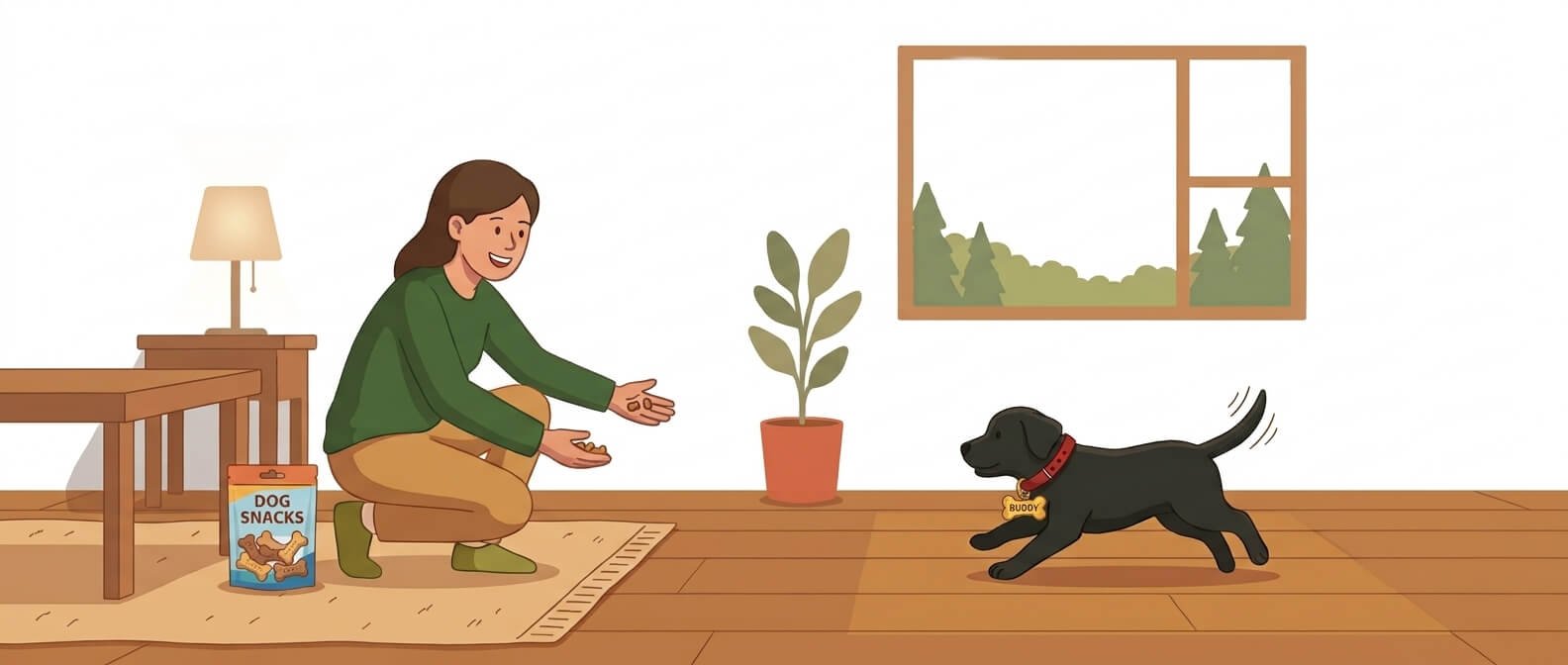
Start where your dog can't fail. Indoors, in a quiet room, with no other people or pets around. This is the foundation of how to train a dog recall.
Step-by-Step
Stand a few feet from your dog. Say their name, then your recall word—”Come!” or “Here!”—in a bright, happy voice.
Praise the instant they look at you. Even if they just glance, mark it with a “Yes!” or a clicker sound.
Reward generously when they reach you. Multiple treats, one after another.
Repeat. Gradually increase the distance. Call them from across the room, from another room, from upstairs.
Vary the rewards. Sometimes food. Sometimes a tug toy. Sometimes just excited praise and a belly rub.
Choosing Your Recall Word
Pick a word you’ll use consistently. Options include:
“Come”—classic and clear
“Here”—used in many training programs
“Front”—used in competition obedience
A whistle—can be heard from far away
Avoid using your dog’s name alone as the recall command. Their name should mean “look at me,” not “drop everything and run.” Use a separate word for the full recall.
How Long to Stay in Phase 1
Stay here until your dog responds every single time from any room in the house. This might take 1–2 weeks of short daily sessions (5–10 minutes each).
Quick answer: Phase 1 of how to train a dog recall is indoors, with zero distractions. Stand a few feet from your dog, say their name and your recall word in a happy voice, praise the instant they look at you, and reward generously when they reach you. Gradually increase the distance—across the room, from another room, from upstairs. Pick a consistent recall word (“Come,” “Here,” “Front,” or a whistle) and don’t use your dog’s name alone. Stay in Phase 1 until they respond every single time. This usually takes 1–2 weeks of 5–10 minute sessions.
Part 4
Phase 2: Enclosed Outdoor Space (Low Distractions)
Once your dog is solid indoors, move to a fenced yard or other secure outdoor space. This is where outdoor dog safety training starts to feel real.
Step-by-Step
Start close. Your dog is in a fenced yard. Stand a few feet away and call them.
Reward heavily when they come.
Gradually increase distance. Call them from across the yard.
Add mild distractions. Ask a family member to walk by in the background. Wait until a bird flies overhead.
Practice at different times of day. Different lighting, different sounds, different energy levels.
What to Watch For
If your dog doesn’t come, don’t repeat the command. One call. If they ignore it, they’re not ready for this level of distraction.
Go back a step. Return to indoor training for a few days. Then try the yard again.
Never, ever punish a slow or failed recall. Just reduce the difficulty.
How Long to Stay in Phase 2
Stay here until your dog responds in the yard, every time, even when mildly distracted. This might take 2–4 weeks.
Quick answer: Phase 2 of how to train a dog recall moves outdoors to a fenced yard. Start close, reward heavily, and gradually increase distance. Add mild distractions—a family member walking by, a bird flying overhead—and practice at different times of day. If your dog doesn’t come, don’t repeat the command. One call. If they ignore it, they’re not ready for this level of distraction—go back a step. Never punish a slow or failed recall. This phase usually takes 2–4 weeks.
Part 5
Phase 3: Long Leash Practice (Controlled Distractions)
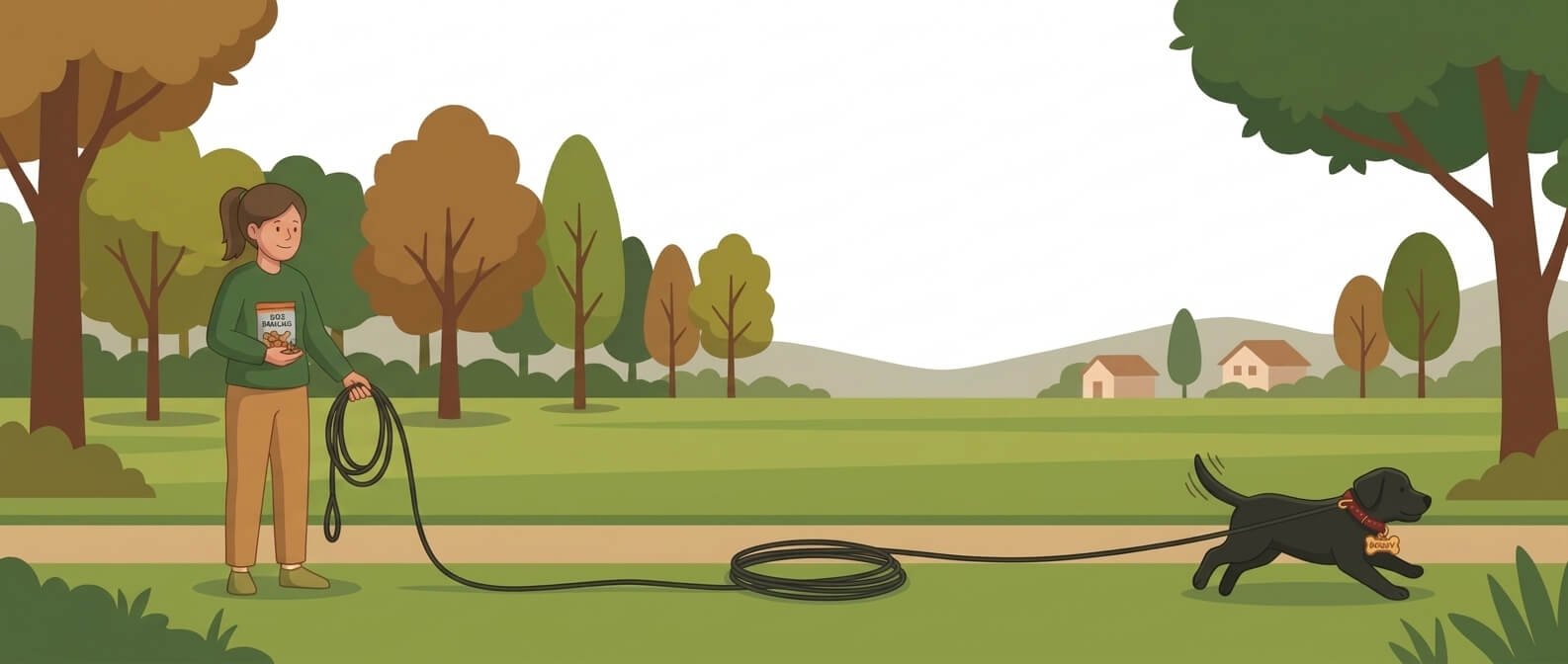
Now it's time to practice in public places with more distractions—but with a safety line attached.
What You Need
A long leash (15–50 feet / 4.5–15 meters)
A harness (not a flat collar—long lines can cause neck injury if your dog hits the end at speed)
High-value treats
A quiet park or open field
Step-by-Step
Attach the long leash. Let it drag on the ground.
Let your dog explore. Give them space to wander and sniff.
Call them. Use your recall word in a happy voice.
If they come: Reward heavily. Celebrate.
If they don’t come: Gently use the leash to guide them toward you. Don’t yank or drag—just apply steady pressure and reel them in.
Reward them when they reach you—even if you had to use the leash. This is critical. They still came to you. Make it positive.
Building Up Distractions
Gradually practice in more challenging environments:
A park with other dogs in the distance
Near a walking trail with people passing by
At the edge of a dog park (outside the fence)
The "Never Call Unless You Can Enforce" Rule
This is one of the most important rules in recall training:
Never call your dog if you can’t physically make them come.
If you’re in an unfenced area and they’re off-leash, and you don’t have a long line attached, don’t call them unless you’re certain they’ll respond. If you call and they ignore you, they just learned that “come” is optional.
Quick answer: Phase 3 of how to train a dog recall uses a long leash (15–50 feet) in public places with more distractions. Attach the long leash, let your dog explore, then call them in a happy voice. If they come, reward heavily. If they don’t, gently use the leash to guide them—never yank or drag. Reward them when they reach you, even if you had to use the leash. And remember the “Never Call Unless You Can Enforce” rule: don’t call your dog if you can’t physically make them come.
Part 6
Phase 4: Off-Leash in Safe Areas (High Distractions)
Only when your dog is reliable on the long line in multiple environments can you consider off-leash work.
Before You Go Off-Leash
Your dog should:
Respond consistently on the long line in 3+ different environments
Come when called away from moderate distractions (other dogs, people, squirrels)
Have a strong reinforcement history—they come because they want to
Step-by-Step
Start in a safe, enclosed area. Fenced fields, dog parks, or private property.
Call your dog when they’re not too far away.
Reward with the highest-value treats possible—rotisserie chicken, cheese, hot dogs.
End on a high note. Call them, reward, then let them go play again. Don’t make “come” mean “the fun is over.”
The "Bring Them In, Send Them Out" Strategy
This is the secret to a recall that doesn’t get poisoned by “come means leaving.”
Always have two recall sessions:
Call them to you. Reward heavily. This is the “come” part.
After they eat their reward, release them back to play. “Go play!” or “Free!”
Repeat.
If you always call your dog just to put them on a leash and go home, they’ll start avoiding you. Make sure at least 50% of recalls end with them being released back to fun.
Quick answer: Phase 4 of how to train a dog recall is off-leash work—but only after your dog responds reliably on a long line in 3+ different environments. Start in a safe, enclosed area (fenced field, private property). Call your dog when they’re not too far away, reward with the highest-value treats, and end on a high note. Use the “Bring Them In, Send Them Out” strategy: call them, reward, then release them back to play. Make sure at least 50% of recalls end with them being released back to fun—otherwise “come” becomes “the fun is over.”
Part 7
Advanced Recall: Emergency Stop and "Gotta Go" Words
Once the basic recall is solid, consider adding a few advanced tools.
The Emergency Recall
This is a special word you use only in emergencies—when you need your dog to come immediately, no matter what.
How to train it:
Pick a unique word. “Emergency!” “Away!” “Eek!”—something you never use casually.
Start indoors. Say the word in a high, excited voice. When your dog comes, give them the best reward ever—a whole hot dog, a piece of steak, a handful of cheese.
Practice rarely. Once or twice a month, in different locations, always with a huge reward.
Never overuse it. The power of the emergency recall comes from its rarity. Use it too often, and it loses its magic.
The "Gotta Go" Word
Some trainers use a casual word for everyday recalls and a separate word for “this is serious.”
Everyday recall: “Come” or “Here”
Emergency recall: “Away!” or a whistle
This gives you two levels of response—one for routine, one for emergencies.
Quick answer: Once basic recall is solid, you can add two advanced tools to your how to train a dog recall toolkit. The emergency recall uses a unique word (“Emergency!” “Away!” “Eek!”) that you use only in true emergencies—paired with the best reward ever (a whole hot dog, a piece of steak). Practice it rarely (once or twice a month) so it doesn’t lose its power. The “gotta go” word gives you two levels of response: one for routine recalls (“Come” or “Here”), one for serious situations (“Away!” or a whistle).
Part 8
Common Mistakes and How to Avoid Them
Here are the most common recall mistakes—and how to fix them.
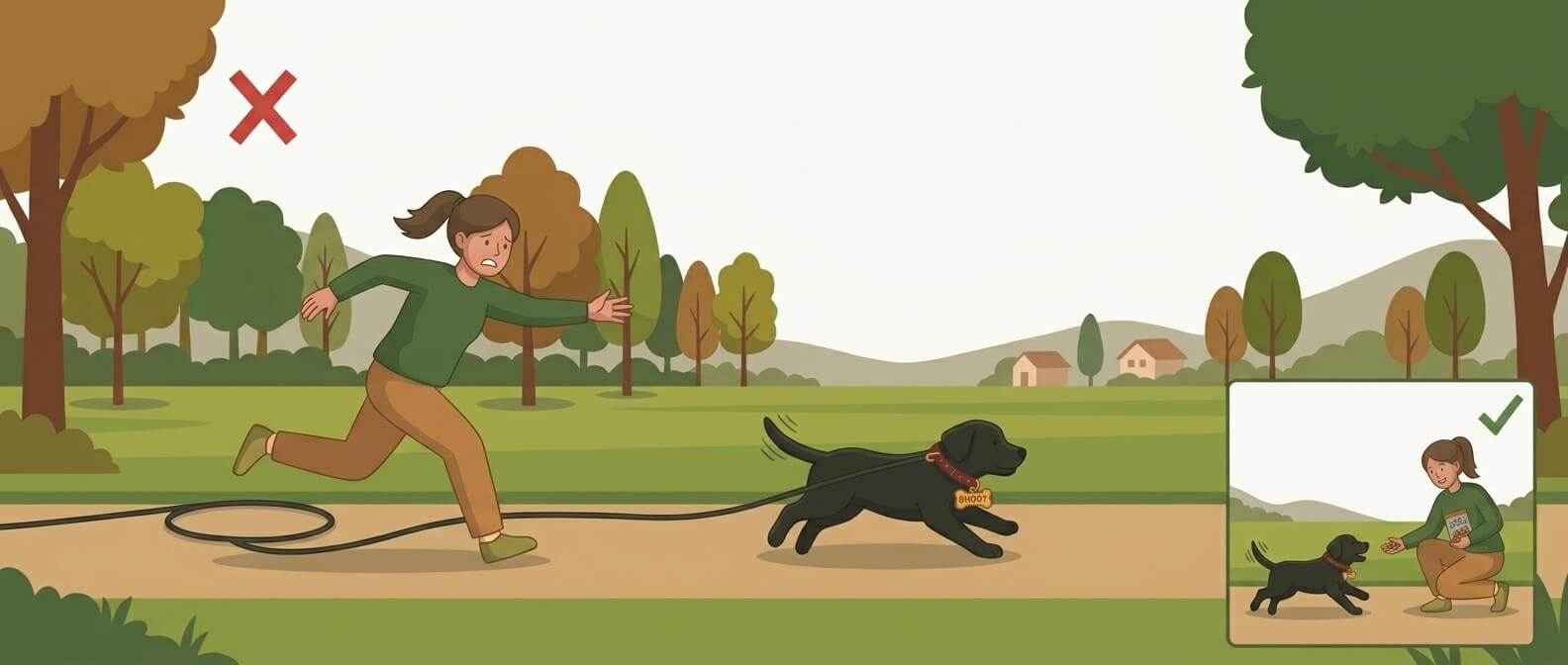
Mistake 1: Using the Command When You Can't Enforce It
The problem: You’re in an unfenced area. Your dog is off-leash. You call them. They ignore you. You can’t make them come.
The fix: Only call your dog when you can physically enforce it (long line) or when they’re reliable enough to respond.
Mistake 2: Punishing a Slow Recall
The problem: Your dog takes a long time to come. When they finally get to you, you scold them for being slow.
The fix: Reward them anyway. The recall itself is the win. Punishing a slow recall teaches your dog that coming to you is risky.
Mistake 3: Calling Too Often
The problem: You call your dog constantly—every few minutes—until they start ignoring you.
The fix: Let your dog be a dog. Use their name to check in, but save the recall command for times when you actually need them to come.
Mistake 4: Not Rewarding Enough
The problem: You give a kibble for a recall from a squirrel chase. That’s not enough.
The fix: For high-distraction recalls, use the highest-value reward you can. Rotisserie chicken. Cheese. Hot dogs. The reward should match the difficulty.
Mistake 5: Stopping Training Too Soon
The problem: Your dog recalls perfectly in the house. You assume they know it. You never practice in public.
The fix: Recall training is never truly “done.” Practice regularly in different places, with different distractions. It’s a lifelong skill.
Quick answer: The five most common mistakes in how to train a dog recall are: (1) calling your dog when you can’t enforce it—only call when you have a long line or your dog is reliable; (2) punishing a slow recall—reward them anyway; (3) calling too often—save the recall command for when you actually need it; (4) not rewarding enough—match the reward to the difficulty (rotisserie chicken, cheese, hot dogs for high-distraction recalls); (5) stopping training too soon—recall is a lifelong skill, not a one-time lesson.
Part 9
Recall Games to Keep Training Fun
Training doesn't have to be boring. These games make recall practice fun for both of you.
Recall Games to Keep Training Fun
Training doesn’t have to be boring. These games make recall practice fun for both of you.
Game 1: The Name Game
Two people stand at opposite ends of a room.
One person calls the dog.
Dog runs to them. Reward heavily.
The other person immediately calls the dog.
Dog runs back. Reward.
Repeat like a game of ping-pong.
Game 2: Hide and Seek
You hide in a room or behind furniture.
Someone holds the dog.
You call the dog.
Your dog has to “find” you to get the reward.
Game 3: The Recall Race
Two people stand at opposite ends of a yard.
Each has treats.
One person calls the dog. Dog comes. Reward.
The other person immediately calls. Dog races over. Reward.
Turn it into a fun race.
Game 4: Treat Toss
Call your dog to you. Reward.
Toss a treat a few feet away.
Let your dog eat it.
When they look back at you, call them again and reward.
Repeat. This builds engagement and checking in with you.
Quick answer: Recall training doesn’t have to be boring. Four games make it fun: (1) The Name Game—two people call the dog back and forth across a room; (2) Hide and Seek—you hide and call the dog to “find” you; (3) The Recall Race—two people call the dog back and forth across a yard; (4) Treat Toss—toss a treat a few feet away, then call the dog back. These games build engagement, speed, and the habit of checking in with you—all essential to how to train a dog recall.
References & Further Reading
The information in this guide is based on research and insights from the following sources:
American Veterinary Medical Association (AVMA) — Preventable accidents and pet safety
American Kennel Club (AKC) — Recall training best practices
Humane Society of the United States — General pet training guidelines
Pet Professional Guild — Force-free training principles
Professional trainers and behaviorists — Phase-based recall training methodology
Disclaimer: I’m a dog owner, not a professional dog trainer. This content is for informational purposes only and does not replace professional training advice. For any concerns about your specific dog—especially recall-related issues—please consult a certified trainer or behaviorist.
FAQ: Breakaway Collar vs Flat Collar for Dogs
It depends on the dog, but expect at least 3–6 months of consistent practice for a reliable recall—and longer for high-distraction environments. The phased approach (indoors → yard → long leash → off-leash) helps you build reliability gradually. Don't rush it. A dog that recalls 100% indoors is not ready for off-leash work yet.
Yes. Older dogs can absolutely learn a reliable recall—it just takes patience and consistency. You may need to start at Phase 1 (indoors) even if your dog has years of bad habits. Go slowly, reward heavily, and never punish a slow recall. Age is not a barrier—inconsistency is.
This is the most common recall problem—and the answer is simple: your dog isn't ready for off-leash work at the dog park yet. Go back to Phase 3 (long leash practice) in quieter environments. Build reliability there first, then gradually add distractions. The dog park is one of the hardest places to train recall—don't start there.
Some dogs are too stressed or distracted to eat outside. Try higher-value treats (rotisserie chicken, hot dogs, cheese), or use a toy reward instead (tug, ball). If your dog won't take anything, the environment is too distracting—go back to a quieter setting and rebuild from there.
A clicker can help—but it's not required. A clicker "marks" the exact moment your dog does the right thing, which can speed up learning. If you use one, pair it with a treat every time. If you don't want to carry a clicker, a verbal marker like "Yes!" works just as well.
A normal recall ("Come" or "Here") is used for everyday situations—calling your dog back during a walk, at the park, or from the yard. An emergency recall uses a unique word ("Emergency!" "Away!") that you use only in true emergencies, paired with the best reward ever (a whole hot dog, a piece of steak). You practice it rarely so it keeps its power.
Usually because of distraction level. Your dog may be reliable in low-distraction environments (indoors, quiet yard) but not in high-distraction environments (dog park, busy trail). This isn't disobedience—it's just where your dog is in the training process. Go back a step, rebuild reliability, and gradually add distractions.
Yes. A whistle can be an excellent recall cue—especially for dogs who work at a distance. It's consistent (no tonal variation), carries far, and is easy to hear. Many hunters and outdoor trainers use whistles for exactly this reason. Pick a specific whistle pattern and use it consistently.
No—use a separate word. Your dog's name should mean "look at me," not "drop everything and run." If you use their name as the recall command, they'll start ignoring it (because you say it constantly). Pick a distinct word like "Come," "Here," or "Front" for the full recall.
This is common—and it usually means your dog is uncertain or hasn't been rewarded enough for coming all the way in. Don't reach for them or grab their collar (which can feel like punishment). Instead, crouch down, speak softly, and reward heavily when they close the last few feet. Practice "coming all the way in" as its own skill.
Recall Training Checklist
☐ Choose a recall word (not your dog's name)
☐ Practice 5–10 minutes daily
☐ Use high-value treats
☐ Reward every single recall
☐ Increase distance gradually
☐ Practice from different rooms
□ Practice in a fenced yard or secure area
□ Start close and increase distance
□ Add mild distractions gradually
□ Reward every recall
□ Don't move on until consistent
☐ Use a 15–50 foot (4.5–15 m) long leash
☐ Attach to a harness, not a flat collar
☐ Practice in low-distraction public areas
☐ Gently guide your dog with the leash if needed
☐ Reward every recall, even with leash guidance
☐ Never call if you can't enforce
□ Only in safe, enclosed areas
□ Use high-value rewards
□ Practice "bring them in, send them out"
□ Never call just to end the fun
□ Practice regularly, even when solid
□ Practice recall weekly in different locations
□ Randomly reward recalls (variable reinforcement)
□ Special rewards for exceptional recalls
□ Don't overuse the command
A Final Thought
A reliable recall can save your dog’s life.
Breakaway collar vs flat collar—protects physical safety.
Microchip vs GPS tracker—brings them home if lost.
But a recall prevents the loss in the first place.
It stops the chase. It calls them back from danger. It turns a potential crisis into a non-event.
Train it. Practice it. Reward it. Every single time.
Your dog’s life may one day depend on it. That’s why knowing how to train a dog recallmatters more than any other skill you’ll teach.
More in This Series
This article is part of our Lost Dog Prevention series. Explore the other guides below.
Lost Dog Prevention: The Complete Guide to Microchips, ID Tags, and GPS Trackers — Start with the complete guide, then dive into each layer in detail.
Dog Microchip vs GPS Tracker: Which One Does Your Pup Need? — A head-to-head comparison to help you choose.
What to Do If Your Dog Gets Lost: Step-by-Step Emergency Plan — Your action plan for the first hour and beyond.
Breakaway Collar vs Flat Collar for Dogs: Safety Trade-Offs Explained — Which collar is right for your dog’s lifestyle?
All part of the Lost Dog Prevention module here on OutdoorDogSafety.com.
Disclaimer: This content is for informational purposes only and does not constitute veterinary or professional safety advice. Always consult with a qualified veterinarian or professional dog trainer regarding your dog’s specific needs and safety considerations.