
Hot Car Dangers for Dogs:
Why Parked Cars Are Deadly
Hot car dangers for dogs are real—even on mild days. Learn how fast temperatures rise, signs of heatstroke, and what to do if you see a dog in a hot car.
Let me start with something that might save a life.
On a 70-degree day, the inside of a parked car can reach 89 degrees in just 10 minutes. After 40 minutes, it hits 108 degrees. At that temperature, a dog will likely die of heatstroke.
Even on a mild 60-degree day, a closed car can reach 105 degrees after an hour. And when it’s 80 degrees outside? Just 10 minutes inside a parked car can be fatal to a dog.
Here’s the thing about hot car dangers for dogs: they don’t require scorching summer weather. A “not that hot” day can still be deadly. Dogs left in vehicles are at serious risk of heatstroke, organ failure, and death—and it can happen faster than most people realise. According to the AVMA, hundreds of pets die in hot cars every year—and many of those deaths happen on days that felt “mild” to their owners.
In this guide, we’ll cover everything you need to know about hot car dangers for dogs: how fast temperatures rise, why dogs can’t handle the heat, the symptoms of heatstroke, what to do if you see a dog in a hot car, and how to keep your dog safe. This is one of the most urgent topics in dog travel safety—and a key part of outdoor dog safety.
What's in This Guide
In this guide, I’ll walk you through:
-
Part 1: Why parked cars are death traps — the science behind hot car dangers for dogs
-
Part 2: How fast temperatures rise in a parked car
-
Part 3: Why dogs overheat so quickly
-
Part 4: Signs of heatstroke in dogs
-
Part 5: What to do if your dog shows signs of heatstroke
-
Part 6: What to do if you see a dog in a hot car
-
Part 7: The law — is it illegal to leave a dog in a hot car?
-
Part 8: Which dogs are most at risk
-
Part 9: Hot weather safety tips
-
Checklist: Hot car safety checklist
-
FAQ: Frequently asked questions
-
A Final Thought: A heartfelt wrap-up
The bottom line: Hot car dangers for dogs aren’t just a summer problem—they’re a year-round risk that’s entirely preventable. This guide will show you how.
Let’s get started.
Part 1
Why Parked Cars Are Death Traps
Understanding the science behind hot car dangers for dogs is the first step to taking them seriously. A parked car isn't just uncomfortable—it's a giant oven for your dog.
Cars are made of metal and glass, both excellent at retaining heat. When the sun hits a parked car, the interior works like a solar collector. The greenhouse effect traps heat inside, and temperatures climb at a terrifying rate.
The problem isn’t just the heat itself. It’s the speed. A car can go from comfortable to lethal in the time it takes to run a “quick” errand. And unlike a human, a dog can’t simply roll down the window or get out.
A parked car with windows cracked is still a deadly place. Shade doesn’t help much either—the sun moves, and the temperature still rises. The RSPCA confirms that dogs can still overheat even when the windows are down or the car is parked in a shaded area. These are the hot car dangers for dogs that every owner must understand.
Quick answer: A parked car works like a solar collector—metal and glass trap heat, and interior temperatures climb at a terrifying rate. The problem isn’t just the heat; it’s the speed. A car can go from comfortable to lethal in the time it takes to run a “quick” errand. Cracking the windows or parking in the shade doesn’t help enough. The RSPCA confirms dogs can still overheat even with windows down or in shaded areas. That’s why hot car dangers for dogs are a year-round risk—not just a summer problem.
Part 2
How Fast Temperatures Rise in a Parked Car
Understanding how fast a car heats up is what makes these numbers so chilling. It's not about hours—it's about minutes.
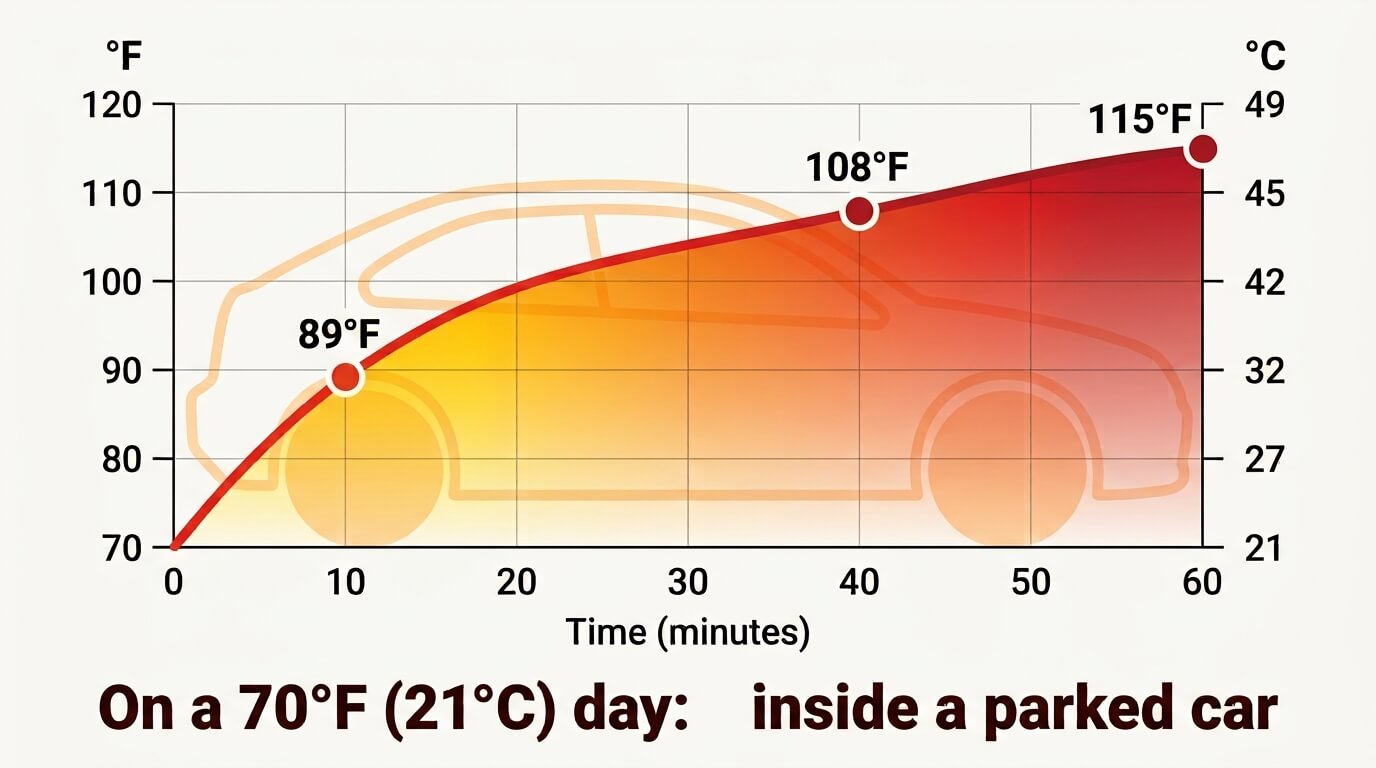
According to research from San Francisco State University, here’s how fast the temperature inside a parked car rises on a 70°F day:
Time Elapsed | Inside Temperature |
|---|---|
10 minutes | 89°F |
20 minutes | 99°F |
30 minutes | 104°F |
40 minutes | 108°F |
When the outside temperature is 90°F, just 10 minutes inside a parked car can be fatal to a dog. Vehicles can reach up to 163°F (73°C) on a hot summer’s day.
What about a 60°F day? At 60 degrees outside, after just one hour a closed car can get as hot as 105 degrees. Research from RSPCA Queensland confirms that even when the temperature outside is a mild 72°F (22°C), the temperature inside a parked car can rise to over 117°F (47°C).
In short: hot car dangers for dogs exist on almost any warm day. You don’t need a heatwave to put your dog at risk. This is the reality behind dog travel safety—the danger is often invisible until it’s too late.
Quick answer: Research from San Francisco State University shows how fast a parked car heats up on a 70°F day: 89°F in 10 minutes, 99°F in 20 minutes, 104°F in 30 minutes, and 108°F in 40 minutes. On a 90°F day, 10 minutes can be fatal. Even on a mild 60°F day, a closed car can reach 105°F after an hour. Research from RSPCA Queensland confirms that even at 72°F (22°C) outside, the inside of a parked car can rise above 117°F (47°C). Hot car dangers for dogs exist on almost any warm day—you don’t need a heatwave to put your dog at risk.
Part 3
Why Dogs Overheat So Quickly
Dogs are not built for heat the way we are. This is why hot car dangers for dogs are uniquely deadly.
Dogs don’t sweat. Instead, they cool themselves down through panting—evaporative cooling from the lungs and mouth—and by lying on cool surfaces. This system works well in normal conditions, but it’s not designed for the intense heat of a parked car.
A dog’s normal body temperature is in the 101–102.5°F (38.3–39.2°C) range. Body temperatures above 105°F (41°C) are suggestive of heatstroke. When a dog’s body temperature reaches 107–108°F (41.7–42.2°C), it’s likely they will die without immediate intervention.
The progression is brutal: As heat increases, a dog’s heart begins to fail, blood pressure drops, organs go into shock, and the body starts to shut down. Even if you can reverse the physical damage and save their life, dogs can suffer brain damage that causes personality changes, sensory loss, and cognitive problems.
When dogs are trapped in hot cars, they can die of heatstroke in as little as 15–30 minutes. Heatstroke is a serious condition that can damage every organ in the dog’s body. This is why understanding hot car dangers for dogs is so critical.
Quick answer: Dogs don’t sweat like humans—they cool themselves primarily through panting, which isn’t designed for the intense heat of a parked car. A dog’s normal body temperature is 101–102.5°F (38.3–39.2°C). Above 105°F (41°C) suggests heatstroke; at 107–108°F (41.7–42.2°C), death is likely without immediate intervention. The progression is brutal: heart failure, blood pressure drop, organ shock, and shut down. Even if a dog survives, they can suffer permanent brain damage. Hot car dangers for dogs are deadly because dogs can die in as little as 15–30 minutes.
Part 4
Signs of Heatstroke in Dogs
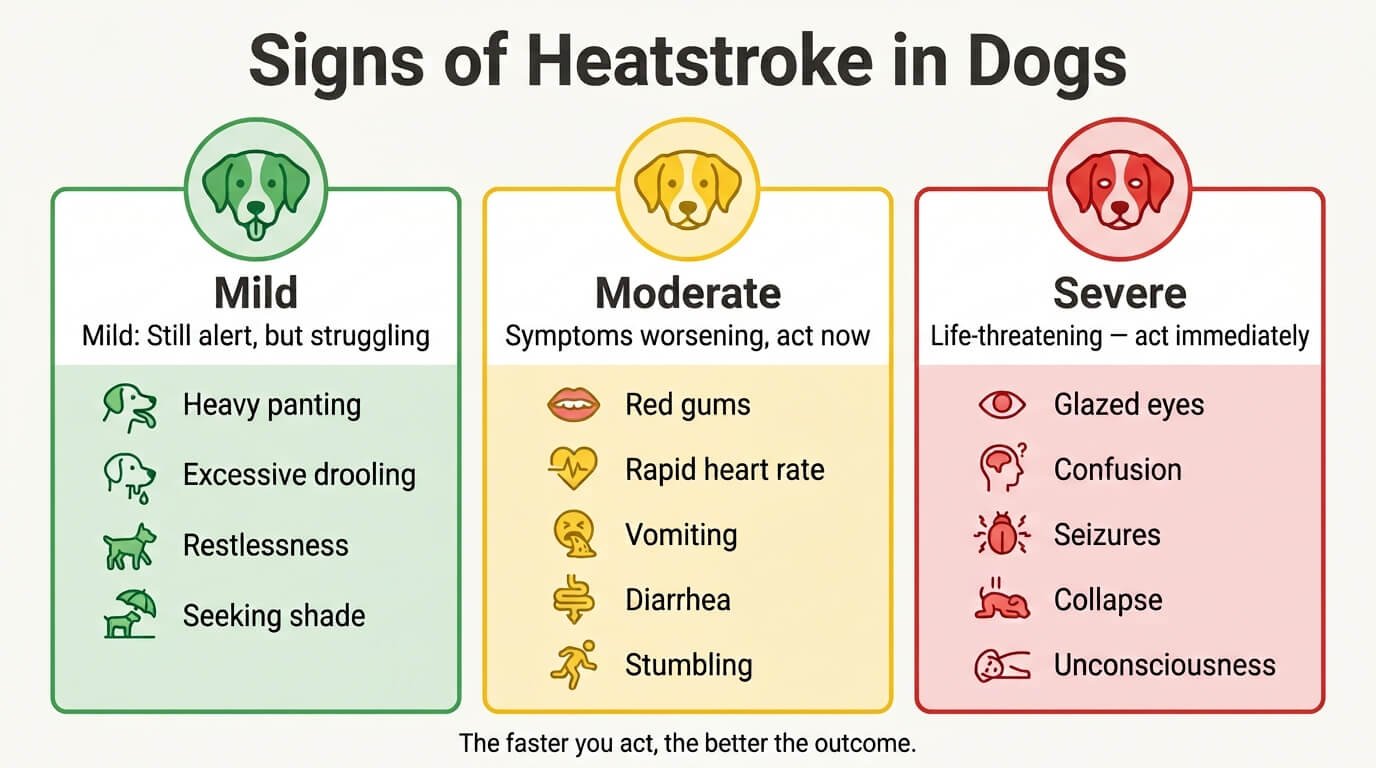
Recognizing the symptoms of heatstroke early can save your dog's life. Here's what to watch for when hot car dangers for dogs become a reality.
Early Signs
-
Heavy panting that doesn’t stop
-
Excessive drooling or hypersalivation
-
Glazed eyes
-
Lethargy or listlessness
-
Restlessness
-
Brick red or pale gums
Progressive Symptoms
-
Vomiting or diarrhea (sometimes bloody)
-
Rapid heartbeat (over 140 beats per minute for medium dogs)
-
Weakness or collapse
-
Disorientation or confusion
Late-Stage Signs
-
Seizure activity
-
Unconsciousness
-
Multiple organ failure
-
Death
Prognosis: Heatstroke causes death in upwards of 50% of dogs affected. Survival depends on how quickly the dog is rescued and treated. The overall fatality rate for heat-related illness cases has been reported at 7.86%.
If you want the specific studies behind these numbers, ask your vet—they can point you to the latest research.
Quick answer: The early signs of heatstroke in dogs include heavy panting that won’t stop, excessive drooling, glazed eyes, lethargy, restlessness, and brick red or pale gums. As it progresses: vomiting, rapid heartbeat (over 140 bpm for medium dogs), weakness, collapse, and disorientation. Late-stage signs include seizures, unconsciousness, multiple organ failure, and death. Heatstroke kills upwards of 50% of affected dogs—survival depends on how fast you act. Recognizing these signs early is the most critical skill when it comes to hot car dangers for dogs.
Part 5
What to Do If Your Dog Shows Signs of Heatstroke
If you suspect heatstroke from hot car dangers for dogs, every minute counts. Here's the emergency protocol—and what not to do.
Immediate Steps
-
Move the dog to a cool, shaded area with good air circulation immediately.
-
Offer small amounts of cool (not ice-cold) water. Ice water can cause shock.
-
Apply cool water to their paws, ears, and groin. These areas cool them fastest. Spray cool water on their body but never immerse them in cold water or surround them with ice.
-
Fan them to help evaporation.
-
Get to a veterinarian immediately. Heatstroke is a medical emergency
Emergency Treatment
Once in professional care, the dog will be cooled down and given intravenous fluid therapy. They will receive monitoring of internal organ function and blood coagulation, plus medications to protect the gastrointestinal system. Treatment usually lasts two to three days or longer.
Don’t wait. Heatstroke is very serious and causes death in up to 50% of dogs affected. Further hospital treatment has to take place immediately. This is why dog travel safetymatters so much—prevention is always better than emergency care.
Don’t wait. Heatstroke is very serious and causes death in up to 50% of dogs affected. Further hospital treatment has to take place immediately.
Quick answer: If your dog shows signs of heatstroke, act immediately: (1) move them to a cool, shaded area with good air circulation; (2) offer small amounts of cool—not ice-cold—water (ice water can cause shock); (3) apply cool water to their paws, ears, and groin—these areas cool them fastest; (4) fan them to help evaporation; (5) get to a vet immediately. Never immerse them in cold water or surround them with ice. Heatstroke kills up to 50% of affected dogs—every minute counts. This is why acting fast on hot car dangers for dogs is so critical.
Part 6
What to Do If You See a Dog in a Hot Car
Hot car dangers for dogs don't just affect your own dog—you might be the one who saves someone else's pet.
Step 1: Assess the Situation
Look for signs of heatstroke: heavy panting, drooling, glazed eyes, weakness, or collapse. If the dog appears to be in distress, act quickly.
Step 2: Call Authorities
-
Call your local emergency number or law enforcement immediately. In many areas, it’s a crime to leave a dog in a dangerous situation. If you’re not sure who to call, start with the police—they can direct you to the right agency.
-
In the U.S., call 911. In Australia, call the RSPCA Cruelty Hotline (1300 278 358) or local police. In the U.K., call 999 or the RSPCA (0300 1234 999). In Canada, call your local police or provincial animal welfare agency.
-
Provide the vehicle details: color, make, model, license plate number, and location.
Step 3: Try to Find the Owner
Ask nearby stores or businesses to page the vehicle owner.
Step 4: Stay With the Dog
Keep an eye on the dog until help arrives. Maintain a suitable distance so you don’t agitate them and make the situation worse.
Step 5: Gather Evidence
Take photos of the dog in the vehicle and note the time, date, and vehicle details. This can help with any legal action.
What if Authorities Don't Respond Quickly?
If it looks like the dog’s life is in serious danger and authorities haven’t arrived, find a witness to back up your decision and take steps to remove the suffering animal. Stay with the dog until help arrives. The owner of the car can get a new window—a dead dog can’t be brought back.
Note: Laws about breaking a car window to rescue a pet vary by region. Check your local laws before acting—and document everything.
Quick answer: If you see a dog in a hot car, act fast: (1) assess the situation—look for heavy panting, drooling, glazed eyes, weakness, or collapse; (2) call your local emergency number or law enforcement (911 in the U.S., 999 in the U.K., RSPCA hotline in Australia); (3) try to find the owner through nearby stores; (4) stay with the dog until help arrives, keeping a calm distance; (5) gather evidence—photos, time, date, and vehicle details. If authorities don’t respond quickly and the dog’s life is in danger, find a witness and take steps to remove the animal. Note: laws about breaking a window vary by region. Hot car dangers for dogs aren’t just about your own pet—you might be the one who saves someone else’s.
Part 7
What to Do If You See a Dog in a Hot Car
In many places, leaving a dog in a hot car is not just one of the hot car dangers for dogs—it's a crime.
Pet owners have a legal duty of care to ensure their animals are safe and protected from harm, including heat stress.
United States
-
In Orange County, North Carolina, it is against the law to leave animals inside a parked car if the outside temperature exceeds 70°F (21°C).
-
In many states, leaving an animal in a confined vehicle when it endangers the animal’s life is a crime.
-
Anyone found responsible for leaving a pet alone in a hot car could face criminal charges.
Australia
-
Leaving an animal in a hot car constitutes an offence under the Animal Care and Protection Act 2001, with fines up to $333,800 AUD or three years in jail for a serious breach.
-
In Western Australia, animal cruelty carries a maximum penalty of five years in prison and a $50,000 fine.
Even if it’s not illegal where you live, it’s always dangerous and never worth the risk. That’s the legal side of dog travel safety—and the moral one, too.
Quick answer: In many places, leaving a dog in a hot car is not just dangerous—it’s a crime. In the U.S., many states have laws against leaving an animal in a confined vehicle when it endangers their life; Orange County, North Carolina, specifically bans it when temperatures exceed 70°F (21°C). In Australia, leaving an animal in a hot car is an offense under the Animal Care and Protection Act 2001, with fines up to $333,800 AUD or three years in jail. Even where it’s not illegal, it’s always dangerous and never worth the risk. That’s why understanding hot car dangers for dogs includes knowing the law.
Part 8
Which Dogs Are Most at Risk
Hot car dangers for dogs affect all dogs, but some are especially vulnerable.
Research and veterinary experts consistently identify the following risk factors:
Risk Factor | Why |
|---|---|
Brachycephalic (short-nosed) breeds | Bulldogs, Boxers, Pugs—they have narrower airways and can't pant as effectively |
Older dogs | Reduced ability to regulate body temperature |
Puppies | Immature temperature regulation systems |
Overweight or obese dogs | Extra insulation makes cooling harder |
Long-haired or thick-coated dogs | More insulation = harder to cool |
Dogs with health conditions | Heart, respiratory, or thyroid issues increase risk |
A study of heat-related illness in UK dogs found that brachycephalic breeds had significantly higher odds of environmental heat-related illness compared to medium-skulled breeds. This is why outdoor dog safety is especially important for high-risk breeds—knowing their limits can save their life.
Quick answer: Some dogs are especially vulnerable to heat and are at much higher risk in a hot car. The highest-risk groups are: brachycephalic (short-nosed) breeds like Bulldogs, Boxers, and Pugs—they have narrower airways and can’t pant as effectively; older dogs and puppies—both have reduced ability to regulate body temperature; overweight dogs—extra insulation makes cooling harder; long-haired or thick-coated dogs—more insulation, harder to cool; and dogs with heart, respiratory, or thyroid conditions. A UK study found brachycephalic breeds had significantly higher odds of heat-related illness than medium-skulled breeds. Hot car dangers for dogs affect all dogs—but high-risk dogs need extra caution.
Part 9
Hot Weather Safety Tips
Prevention is always better than cure. Here's how to keep your dog safe from hot car dangers for dogs and heat-related illness.
Never Leave Your Dog in a Parked Car
This is the most important rule: never leave your dog unattended in a car, even for a few minutes, even with windows cracked, even in the shade. If you need to run errands, leave your dog at home. A quick visit to the shops could cost your dog their life. This is the number one rule for avoiding hot car dangers for dogs.
Provide Shade and Water
When your dog is outdoors, ensure they have access to ample shade and multiple water sources all day. Put ice cubes in their water to keep it cool.
Time Walks Wisely
Avoid walking dogs in extreme temperatures. Walk in the cool of the early morning or wait until the evening. Check the ground temperature by placing your palm on the pavement—if you can’t hold it there for five seconds, it’s too hot for your dog’s paws.
Create a Cool Environment
-
Provide a shallow kiddie pool for splashing
-
Make cool DIY doggy treats
-
Ensure good air circulation and access to air conditioning indoors
Know Your Dog's Limits
Be aware of your dog’s breed, age, weight, and health status. Certain dogs require additional precautions.
Cool Down Before Car Travel
Never put your pet inside a car that’s been parked in the sun—the seats could be so hot that they burn your dog. Make sure the car is cooled down ahead of time.
Quick answer: Prevention is always better than cure. For hot weather safety: never leave your dog in a parked car (even with windows cracked or in the shade); provide ample shade and multiple water sources outdoors; walk in the early morning or evening and check pavement with your palm (5-second test); create a cool indoor environment with A/C, airflow, and a kiddie pool; know your dog’s breed, age, weight, and health status; and cool down the car before putting your dog inside. These habits are the core of protecting your dog from hot car dangers for dogs and heat-related illness.
Sources and References
-
American Veterinary Medical Association (AVMA) — Heatstroke and hot car dangers
-
American Animal Hospital Association (AAHA) — Heat safety warnings and heatstroke treatment
-
American Kennel Club (AKC) Canine Health Foundation — Heat stroke and heat exhaustion
-
RSPCA Queensland — Dogs in hot cars and the law
-
RSPCA WA — High temperatures and pet safety
-
San Francisco State University — Vehicle interior temperature research
-
National Institutes of Health (NIH/PubMed) — Heat-related illness in dogs, risk factors, and breed predispositions
-
Orange County Animal Services — Hot car campaign (U.S. regional)
-
New York Department of State — Consumer alert on hot car dangers (U.S. regional)
-
Merck Animal Health — The danger of leaving a dog alone in a car (industry resource)
Disclaimer: I’m a dog owner, not a veterinarian. This content is for informational purposes only and does not replace professional veterinary advice. For any concerns about your specific dog—especially heatstroke or hot car exposure—please consult a licensed veterinarian.faq
FAQ: Hot Car Dangers for Dogs
On a 70°F (21°C) day, a car can reach 89°F (32°C) in 10 minutes and 108°F (42°C) in 40 minutes—at which point heatstroke is likely fatal. On a 90°F (32°C) day, just 10 minutes can be fatal. The RSPCA confirms a dog can die in a hot car in just six minutes. These are the hot car dangers for dogs that every owner must know.
No. Cracking the windows doesn't keep the car cool enough. On a 70°F (21°C) day, the inside of a car can hit 99°F (37°C) in 10 minutes—even with windows cracked. On a 90°F (32°C) day, it can hit 120°F (49°C) in minutes. The RSPCA confirms dogs can still overheat with the windows down. There is no safe way to leave your dog in a parked car.
No. Shade doesn't help enough. The sun moves, and the temperature still rises. A car parked in the shade can still reach dangerous temperatures—especially on hot or humid days. The RSPCA confirms dogs can still overheat even when the car is parked in a shaded area. Never leave your dog in a parked car, even in the shade.
Yes. Heatstroke doesn't require scorching summer weather. On a 60°F (16°C) day, a closed car can reach 105°F (41°C) after an hour. On an 80°F (27°C) day, just 10 minutes inside a parked car can be fatal. A "not that hot" day can still be deadly—that's why hot car dangers for dogs are a year-round risk, not just a summer one.
Act fast: (1) assess the situation—look for heavy panting, drooling, glazed eyes, weakness, or collapse; (2) call your local emergency number or law enforcement (911 in the U.S., 999 in the U.K., RSPCA hotline in Australia); (3) try to find the owner through nearby stores; (4) stay with the dog until help arrives; (5) gather evidence—photos, time, date, and vehicle details. If authorities don't respond quickly and the dog's life is in danger, find a witness and take steps to remove the animal. Note: laws about breaking a window vary by region.
In many places, yes. In the U.S., many states have laws against leaving an animal in a confined vehicle when it endangers their life; Orange County, North Carolina, specifically bans it when temperatures exceed 70°F (21°C). In Australia, leaving an animal in a hot car is an offense under the Animal Care and Protection Act 2001, with fines up to $333,800 AUD or three years in jail. Even where it's not illegal, it's always dangerous and never worth the risk.
Heatstroke is a medical emergency, and survival depends heavily on how fast the dog is cooled and treated. Without immediate intervention, heatstroke kills upwards of 50% of affected dogs. The overall fatality rate for heat-related illness cases has been reported at 7.86%. Survival improves dramatically with quick action—move the dog to shade, apply cool water, fan them, and get to a vet immediately.
Brachycephalic (short-nosed) breeds are at the highest risk—Bulldogs, Boxers, and Pugs have narrower airways and can't pant as effectively. Other high-risk groups include older dogs, puppies, overweight dogs, long-haired or thick-coated dogs, and dogs with heart, respiratory, or thyroid conditions. A UK study found brachycephalic breeds had significantly higher odds of heat-related illness than medium-skulled breeds. Every dog can overheat—but these groups need extra caution.
Checklist: Hot Car Safety Checklist
Before you head out, run through this checklist to protect your dog from hot car dangers for dogs:
☐ Never leave your dog alone in a parked car — no exceptions
☐ Check the temperature — if it’s warm outside, it’s even hotter inside
☐ Leave your dog at home if you’re running errands
☐ Provide shade and water at all times when outdoors
☐ Time walks — early morning or late evening only on hot days
☐ Check pavement — if it’s too hot for your hand, it’s too hot for paws
☐ Know the signs of heatstroke — heavy panting, drooling, glazed eyes
☐ Cool down the car before your dog gets in
☐ Carry emergency contacts — vet number and poison control hotline
A Final Thought
Hot car dangers for dogs are one of the easiest threats to prevent—and one of the deadliest if ignored.
Every summer, too many dogs die in parked cars. The owners usually thought they would be “just a minute.” They thought the windows were “cracked enough.” They thought the day was “cool enough.”
They were wrong. And their dogs paid the price.
The message is simple: never leave your dog alone in a parked car. Not for a few minutes. Not with the windows down. Not in the shade. Not on a “cool” day.
Your dog loves you. They trust you. They want to be with you. Show them you love them back by keeping them safe—at home, in the shade, and out of hot cars.
Your vigilance can make the difference between a dog’s life and death.
More in This Series
This article is part of our Dog Travel & Car Safety series. Here’s what else to explore:
Dog Car Safety: The Complete Guide to Traveling Safely with Your Pup — The complete overview of dog car safety — how to secure your dog in the car, prevent heatstroke, manage car sickness, and pack for road trips.
Crash-Tested Harness vs Crate: Which Is Safer for Your Dog? — Crash-tested dog harness or crate — which is safer? Compare crash test results, costs, and real-world performance to choose the best restraint for your dog.
How to Prevent Car Sickness in Dogs: A Complete Guide — Learn how to prevent car sickness in dogs with training tips, natural remedies, and vet-approved medications — plus practical strategies for calmer, more comfortable car rides.
Road Trip Packing List for Dogs: What to Bring — Planning a road trip with your dog? This road trip packing list for dogs covers everything — food, water, safety gear, first aid, and comfort items.
How to Help an Anxious Dog Enjoy Car Rides: A Complete Guide — How to help an anxious dog enjoy car rides — learn behavioral strategies, desensitization techniques, and when to seek professional help.
All part of the Dog Travel & Car Safety module here on OutdoorDogSafety.com.
Dog car safety starts with a choice. Choose the right restraint for your dog. Never leave them alone in a parked car. Take breaks, bring supplies, and build positive experiences.
Every trip with your dog is a gift. Treat it like one — keep them safe, comfortable, and happy.
Safe travels, from all of us at OutdoorDogSafety.com.