
Dog Car Safety:
Complete Guide to Traveling Safely with Your Pup
Dog car safety starts with the right restraint. Learn how to choose crash-tested harnesses, crates, and barriers—plus road trip tips and hot car dangers.
Let me start with something that might make you uncomfortable.
A 60-pound dog in a 30-mph crash becomes a projectile with the force of 2,700 pounds. That’s like dropping a refrigerator on your backseat—or worse, on the back of your head.
And here’s another one: On a 70°F day, the inside of your car can hit 99°F in just 10 minutes. Not an hour. Ten minutes.
The CDC estimates that around 100,000 dog-related car accidents happen in the U.S. each year. These aren’t just fender-benders. These are crashes caused by dogs jumping onto the driver’s lap, blocking the pedals, or distracting the person behind the wheel.
I’m not saying this to scare you. I’m saying it because I’ve been the person who thought, “She’ll be fine just sitting in the back” and “I’ll only be gone for five minutes.” Most of us have been there.
But here’s the truth: Dog car safety isn’t optional. It’s not a nice-to-have. And it’s not just about protecting your pup—it’s about protecting everyone in that vehicle.
This guide covers everything I’ve learned about keeping dogs safe in cars: restraints, heat dangers, road trip prep, and the mistakes almost all of us make at some point. Let’s dig in.
What's in This Guide
In this guide, I’ll walk you through:
-
Part 1: Why dogs need proper restraints (physics, distractions, and the law)
-
Part 2: Three restraint types compared — crates, harnesses, and barriers
-
Part 3: How to choose the right restraint for your dog
-
Part 4: Helping your dog actually enjoy car rides
-
Part 5: The hot car danger — what every owner needs to know
-
Part 6: Packing for a road trip with your dog
-
Part 7: Common mistakes and safer alternatives
-
Checklist: Dog Car Safety Checklist
-
FAQ: Frequently asked questions
-
A Final Thought: A heartfelt wrap-up
-
What’s Ahead: Upcoming articles in this series
The bottom line: Dog car safety isn’t about one product—it’s about building a safe travel routine. Restraint, heat awareness, and preparation cover almost every risk.
Let’s get started.
Part 1
Why Your Dog Needs a Proper Restraint
Before we talk about which restraint to buy, let's talk about why it matters at all. The short answer: physics doesn't care how well-behaved your dog is. This is the foundation of dog car safety.
The Physics of an Unrestrained Dog
This is the part people don’t want to think about. But understanding the forces at play is the first step to taking them seriously.
When your car stops suddenly—in a crash or even a hard brake—your dog keeps moving at the same speed the car was traveling. If you’re going 30 mph and hit something, your 60-pound Labrador doesn’t weigh 60 pounds anymore. It weighs over a ton. That’s enough force to kill a person.
The American Veterinary Medical Association (AVMA) estimates that an unrestrained 10-pound dog in a 50-mph crash generates about 500 pounds of force. A 60-pound dog? That’s 2,700 pounds of force. Imagine that hitting the back of your seat, the windshield, or your child in the backseat.
And it’s not just crashes. A sudden stop can throw your dog into the dashboard, windshield, or the back of your seat. Even a fender-bender at low speed can cause serious injuries—to your dog and to you.
Distraction: The Everyday Danger
Crashes are the worst case. But distraction is the one that happens far more often—and it’s just as dangerous.
Dogs are curious. They see something interesting outside, they move toward it. That movement might mean climbing into your lap, stepping on the gear shift, or blocking your view of the side mirror.
I’ve had my own dog jump from the backseat to the passenger seat because she spotted a squirrel. It startled me. I swerved. That was the moment I realized: this isn’t about “being a good driver.” It’s about acknowledging that dogs do unpredictable things.
According to the AAA Foundation for Traffic Safety, looking away from the road for just two seconds doubles your risk of a crash. If your dog distracts you for two seconds, that’s enough to change lives forever.
What the Law Says
Beyond safety and common sense, there’s also the legal side. Here’s what drivers need to know across the U.S., UK, Canada, and Australia.
The legal landscape for dog car safety is evolving fast. Here’s what you need to know:
United States: There’s no federal law requiring dog restraints, but many states have distracted driving laws that apply. If a dog sits on your lap and interferes with steering, you can be pulled over and ticketed for reckless driving. Hawaii, Connecticut, and Maine have specific laws against unrestrained pets in vehicles.
United Kingdom: The Highway Code Rule 57 is clear: “When in a vehicle, make sure dogs or other animals are suitably restrained so they cannot distract you while driving or injure you, or themselves, if you stop quickly.” Failure to do so can result in fines up to £2,500 and penalty points on your license.
Canada: Most provinces treat loose pets under distracted driving laws. Penalties vary, but fines can reach several hundred dollars. Ontario and British Columbia are particularly strict.
Australia: Similar rules apply across states, with most requiring that animals be secured so they don’t interfere with the driver. In Queensland, fines for traveling with an unsecured dog can be over $5,000.
Bottom line: Even if your state doesn’t specifically mention dogs, a loose animal that distracts you is a violation of distracted driving laws. And the fines are the least of your worries.
Quick answer: An unrestrained 60-pound dog in a 30-mph crash becomes a projectile with the force of 2,700 pounds—enough to kill a person. Even a low-speed stop can throw your dog into the dashboard or windshield. Distraction is just as dangerous: looking away from the road for two seconds doubles your crash risk. And the law is catching up—many U.S. states, the UK, Canada, and Australia now treat an unrestrained dog as a distracted driving violation. Dog car safety isn’t optional.
Part 2
Three Restraint Types: Compared
Now let's look at the actual products. There are three main categories, and each has a very different level of protection.
Not all restraints are created equal. Here's what you need to know about the three main options for dog car safety.
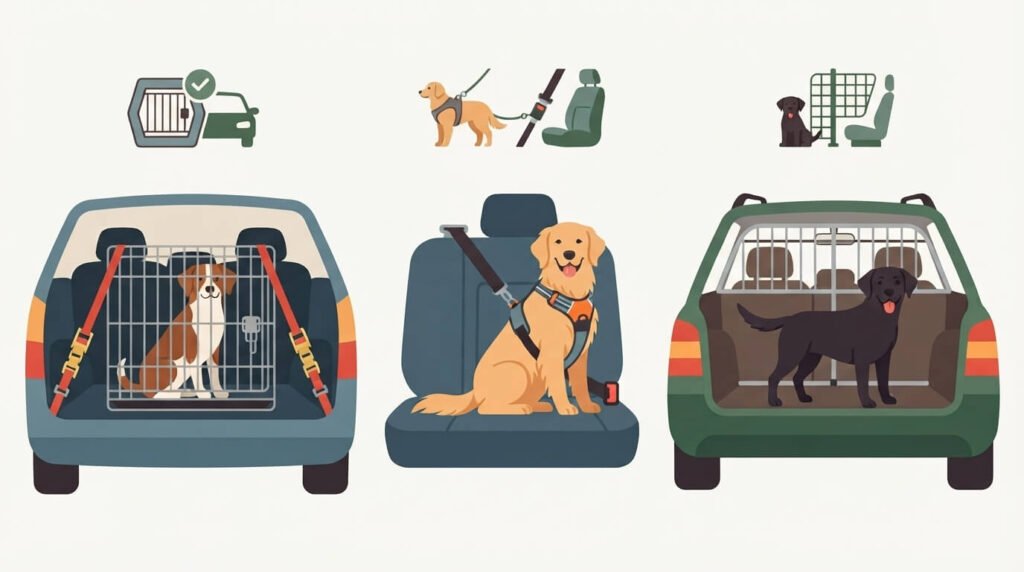
Crash-Tested Crate (Crash-Tested Carrier)
The gold standard. If you have the space and the budget, this gives your dog the most protection possible.
A crash-tested crate is a reinforced crate that’s strapped down inside the vehicle.
Who it’s for: Dogs of all sizes, especially larger breeds. Also great for nervous dogs who feel safer in their own “den.”
Pros:
-
Highest level of crash protection available
-
Contains your dog fully—no roaming, no distraction
-
Keeps cargo area separate from passengers
-
Familiar space can reduce anxiety
-
Often doubles as a crate at your destination
Cons:
-
Takes up significant space (not ideal for compact cars)
-
Can be expensive (often $200–$600+)
-
Heavy and awkward to move in and out
-
Requires proper strapping/anchoring
Crash-Tested Harness
The most practical choice for most dog owners. Affordable, fits any car, and gives solid protection when properly fitted.
This is a dog harness designed specifically for car travel, with a tether that clicks into the seatbelt buckle.
Who it’s for: Medium to large dogs. Good for dogs who do well in the backseat and don’t try to chew their way out.
Pros:
-
Fits any car
-
Easy to put on and take off
-
More affordable than a crate ($40–$150)
-
Dog can sit, stand, or lie down comfortably
-
Good for dogs who prefer being near people
Cons:
-
Less protection than a crate in severe crashes
-
Can twist in a collision if not properly adjusted
-
Only works if perfectly fitted (too loose = dangerous)
-
Some dogs find the tether restricting or chew on it
Barrier/Guard
A popular option for SUVs, but important to understand its limits—it’s more about containment than crash protection.
A barrier is a metal or mesh divider that separates the cargo area from the passenger compartment.
Who it’s for: SUV and wagon owners. Good for dogs who are calm during travel and don’t need a crate.
Pros:
-
Allows the dog to see you
-
Good ventilation
-
Prevents dog from climbing into the front
-
Affordable ($50–$150)
-
Easy to install and remove
Cons:
-
Not crash-tested in most cases
-
Doesn’t actually restrain the dog—just keeps them in the back
-
The dog still slides forward in a crash
-
Can collapse in serious accidents
-
Doesn’t protect the dog from impact
Quick Comparison Table
Restraint Type | Crash Protection | Prevents Distraction | Best For | Cost Range | Certification Available? |
|---|---|---|---|---|---|
Crash-Tested Crate | ★★★★★ | ★★★★★ | All sizes (especially large), nervous dogs | $200–$600+ | Yes (CPS, ADAC) |
Crash-Tested Harness | ★★★★☆ | ★★★★☆ | Medium-large, calm travelers | $40–$150 | Yes (CPS, TÜV SÜD) |
Barrier/Guard | ★★☆☆☆ | ★★★☆☆ | SUVs, dogs who don't roam | $50–$150 | Rarely |
Quick answer: There are three main types of dog car restraints. A crash-tested crateoffers the highest protection ($$$, bulky, best for large or nervous dogs). A crash-tested harness is the most practical for most owners ($40–$150, fits any car). A barrier/guardprevents your dog from climbing into the front but isn’t crash-tested—it’s containment, not protection. For dog car safety, a crash-tested crate or harness is the way to go.
Part 3
How to Choose the Right Restraint
Knowing the options is one thing. Knowing which one fits your dog, car, and lifestyle is the real challenge. Here's how to figure that out. This is the decision that matters most in dog car safety.
Here’s how I think about the choice:
For most people, I recommend a crash-tested harness as a starting point. It’s practical, fits any car, and gives good protection. Brands like SleepyPod, Kurgo, and Ruffwear have models certified by the Center for Pet Safety. They’re affordable enough that you can buy one without overthinking it.
If you have space, a crash-tested crate is the safest option. It’s what I’d use if I could fit one in my car. Some models have passed the rigorous tests conducted by organizations like ADAC (Germany’s automobile club) and TÜV SÜD. Brands like Gunner, Ruff Land, and Variocage lead this category.
Barriers are better than nothing, but I don’t consider them a real restraint. They keep the dog from climbing forward, but they don’t protect the dog in a crash. If a barrier is your only option, make sure it’s properly installed and check reviews for sturdiness. And pair it with a harness if possible.
Certification Matters (More Than You Think)
Here’s the thing: not all harnesses and crates are actually crash-tested. The term isn’t regulated, so brands can say it without proving it. Here’s what to look for instead.
Here’s the thing: not all harnesses and crates are “crash-tested.” The term isn’t regulated, so companies can say it without proving it.
Look for certifications from:
-
Center for Pet Safety (CPS)—independent crash testing for pet products in the U.S.
-
ADAC—German auto club known for extremely rigorous testing
-
TÜV SÜD—German safety certification body
Products that pass these tests are clearly marked. If you don’t see a certification stamp, assume it hasn’t been tested.
Quick Decision Guide
Still unsure? Here’s a simple breakdown based on your dog’s size, temperament, and your vehicle.
If your dog is under 20 lbs:
A crash-tested carrier (small crate) is great. Also consider a harness, but make sure it’s specifically rated for your dog’s size.
If your dog is 20–70 lbs:
A crash-tested harness is the most practical choice for most owners. If you have an SUV or wagon and your dog is calm, a barrier + harness combo works.
If your dog is over 70 lbs:
A crash-tested crate or heavy-duty harness is essential. Not all harnesses work for giant breeds—check size limits carefully.
If your dog is anxious or restless:
A crate often works better because it feels like a den. The enclosed space can help settle them.
If you have a small car:
A harness is usually the only practical option. Crates take up too much space.
The best solution? Match the restraint to your dog, your car, and your budget. A crash-tested harness works for most owners. A crash-tested crate is the safest if you have the space. And a barrier can help—but never rely on it alone.
The best solution? Use both. A small engraved tag with your number provides a reliable fallback, and a QR tag adds modern features like instant notifications.
Quick answer: For most dog owners, a crash-tested harness is the best starting point—practical, affordable, fits any car. If you have space, a crash-tested crate is the safest option. Barriers are better than nothing but aren’t a real restraint. Look for certifications from the Center for Pet Safety, ADAC, or TÜV SÜD—the term “crash-tested” isn’t regulated, so brands can use it without proof. Match the restraint to your dog’s size, temperament, and your car. That’s the practical side of dog car safety.
Part 4
Helping Your Dog Enjoy Car Rides
A restraint only works if your dog actually uses it—without stress, panic, or trying to escape.
A dog who hates the car is a distracted driver waiting to happen. Pacing, crying, and trying to escape are all signs of anxiety. Here's how to build a positive association with car travel.
Start Small
Short, easy wins build trust. Don’t rush straight to a long road trip.
Don’t start with a three-hour road trip. Start by just sitting in the driveway with the engine off, giving treats. Then a short drive around the block. Then a longer loop.
The goal is to teach your dog that “getting in the car” doesn’t always mean “going somewhere stressful.” Sometimes it just means “getting treats with my person.”
Use High-Value Rewards
Make the car the best place on earth. Bring treats your dog doesn’t get anywhere else.
Bring special treats that your dog only gets in the car. My dog gets freeze-dried liver on road trips and nothing else. It keeps her excited about getting in the car instead of anxious about where we’re going.
Create Comfort
A familiar scent can work wonders. Here’s why the RSPCA recommends bringing a piece of home.
Bring a familiar blanket or bed that smells like home. This can dramatically reduce anxiety. In fact, the RSPCA recommends familiar items to help dogs feel secure during travel.
Managing Car Sickness
For dogs who get nauseous on the road, a few simple changes can make all the difference.
Some dogs get motion sickness. If your dog drools excessively, whines, pants, or vomits on car rides, this might be the issue.
Prevention tips:
-
Don’t feed your dog 1–2 hours before travel
-
Keep the car well-ventilated—crack a window slightly (not enough for head-out)
-
Take frequent breaks to let them settle
-
Use a travel crate or harness that allows them to lie flat (helps with balance)
-
Ask your vet about anti-nausea medication for longer trips
Quick answer: To help your dog enjoy car rides, start small (sit in the driveway, then short drives), use high-value rewards only given in the car, and bring a familiar blanket or bed that smells like home. For motion sickness, don’t feed 1–2 hours before travel, keep the car well-ventilated, take frequent breaks, use a travel crate or harness that allows them to lie flat, and ask your vet about anti-nausea medication. A relaxed dog is a safer passenger—that’s the heart of dog car safety.
Part 5
The Hot Car Danger: What Every Owner Needs to Know
This section might be uncomfortable to read. But it's the most important one in this guide. Because the stakes here are life and death.
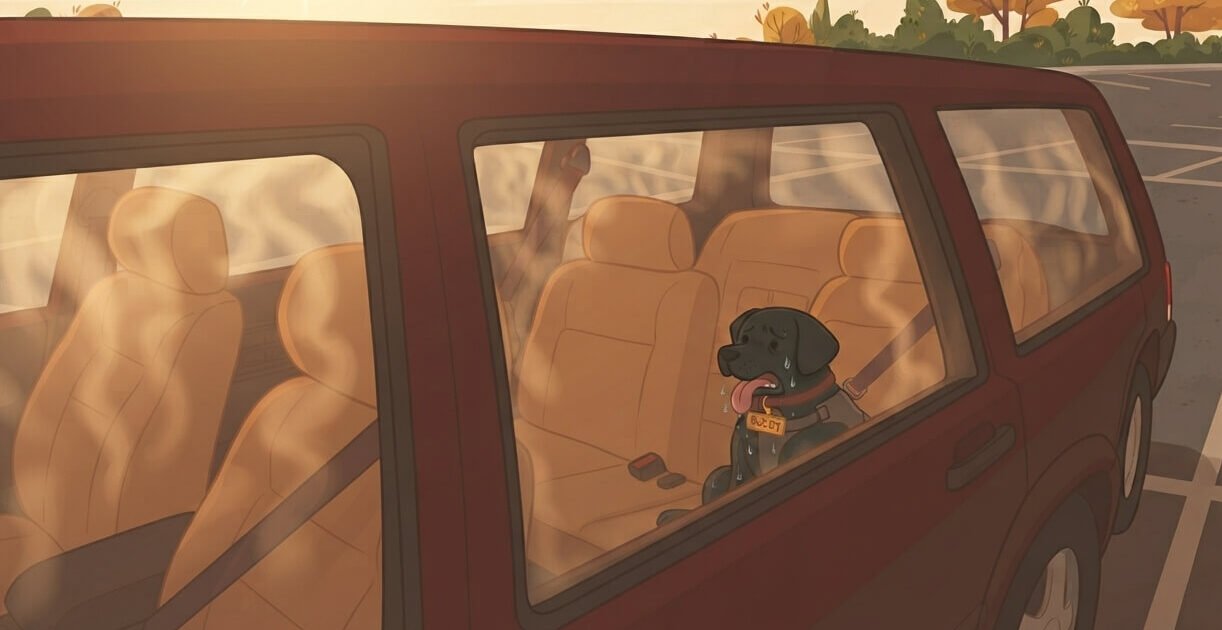
I’ll be direct about this: Never leave your dog alone in a parked car. Not with the windows cracked. Not in the shade. Not for “just a minute.” This is the single most preventable danger in dog car safety.
Here’s what happens:
-
Outside temperature: 70°F
-
Inside your car after 10 minutes: 99°F
-
After 30 minutes: 114°F
On a mild 60°F day, the inside of a parked car can reach 100°F in just 20 minutes. On an 80°F day, it takes only 10 minutes to hit dangerous levels.
And dogs can’t sweat like we can. They cool themselves primarily by panting. Once the temperature inside the car rises above their ability to cool, they begin to overheat, and heatstroke sets in quickly.
Signs of Overheating in Dogs
Recognizing heatstroke early can save your dog’s life. Here’s what to watch for.
-
Excessive panting that doesn’t stop
-
Heavy drooling
-
Glazed eyes
-
Rapid heartbeat (over 140 beats per minute for medium dogs)
-
Weakness or collapse
-
Vomiting or diarrhea
-
Bright red or pale gums
What to Do If You See These Signs
If your dog is showing signs of heatstroke, every minute counts. Here’s what to do—and what not to do.
-
Move the dog to a cool, shaded area immediately.
-
Offer small amounts of cool (not ice-cold) water—ice water can cause shock.
-
Apply cool water to their paws, ears, and groin—these areas cool them fastest.
-
Fan them to help evaporation.
-
Contact a veterinarian immediately—heatstroke is life-threatening.
Even if the outside temperature is mild, a parked car can turn into an oven faster than you think. The heat is also extreme enough that some states have laws allowing bystanders to break windows to rescue an animal in distress. It’s one of the most serious risks in dog car safety—and the easiest to prevent.
Quick answer: Never leave your dog in a parked car—not with the windows cracked, not in the shade, not for “just a minute.” On a 70°F day, the inside of a car can hit 99°F in 10 minutes and 114°F in 30. Dogs cool themselves mainly by panting, so they overheat fast. Signs of heatstroke include excessive panting, heavy drooling, glazed eyes, weakness, and bright red or pale gums. If you see them, move your dog to shade, offer cool—not ice-cold—water, apply cool water to their paws, ears, and groin, fan them, and call your vet immediately. This is the most preventable part of dog car safety.
Part 6
Road Trip Packing Checklist: What to Bring for Your Dog
You've got the restraint, you've trained your dog, and you've checked the weather. Now it's time to pack.
Long drives need planning. Here's what I bring on any trip longer than an hour—the practical side of dog car safety.
Dog Road Trip Essentials
A well-packed car is a stress-free car. Here’s the full list broken down by category.
Food & Water
-
Enough food for the trip, plus extra for unexpected delays
-
Bottled water (avoid unfamiliar tap water that might upset their stomach)
-
Collapsible bowls (one for food, one for water)
-
Treats for breaks and rewards
Health & Safety
-
Copy of vet records (vaccinations, health certificate if crossing borders)
-
First-aid kit with dog-safe supplies (gauze, antiseptic wipes, tweezers, paw balm)
-
Any medications your dog takes regularly
-
Emergency contact for a vet at your destination
Comfort & Cleanup
-
Familiar blanket or bed (smells like home = calm dog)
-
Favorite toy (chew toys are great for keeping them occupied at stops)
-
Poop bags (bring more than you think you need)
-
Towel or wipes for muddy paws or accidents
Identification
-
Collar with up-to-date ID tags
-
Microchip registered with current contact info
-
Recent photo (in case your dog gets lost)
Rest Stops
Taking breaks isn’t just about bathroom needs. It’s about keeping your dog comfortable and preventing travel anxiety.
Plan to stop every 2–3 hours. Your dog needs to stretch, drink water, and relieve themselves.
Before opening the car door: Put the leash on first. Even the most obedient dog can bolt in an unfamiliar place, especially after being cooped up.
Accommodation
If you’re staying overnight, a little advance planning goes a long way.
If you’re staying overnight, book pet-friendly hotels in advance. Call ahead to confirm their pet policy, fees, and any breed restrictions.
Great apps for finding pet-friendly stays: BringFido, Booking.com (filter by “pet-friendly”), and Airbnb (use the “allows pets” filter).
Quick answer: For a road trip with your dog, pack four categories: Food & Water (enough food, bottled water, collapsible bowls, treats), Health & Safety (vet records, first-aid kit, medications, emergency vet contact), Comfort & Cleanup (familiar blanket, favorite toy, poop bags, towel), and Identification (collar with ID tags, microchip registered, recent photo). Plan to stop every 2–3 hours, and always leash your dog before opening the car door. Book pet-friendly hotels in advance and confirm their pet policy. That’s the packing side of dog car safety.
Part 7
Common Mistakes: And What to Do Instead
After years of watching how people (including myself) handle dogs in cars, I've seen the same mistakes over and over. Here are the big ones—and how to avoid them. These are the most common dog car safety mistakes I see.
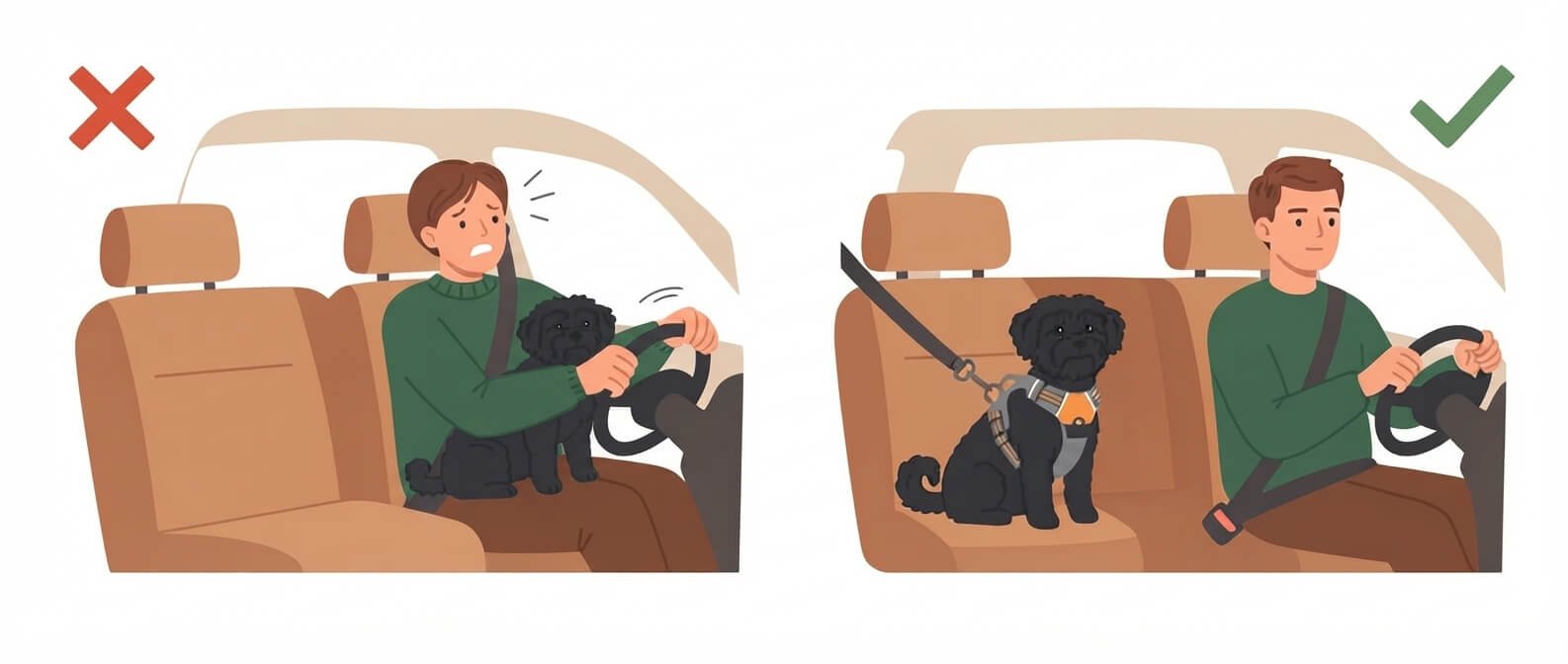
Mistake #1: Not Using a Restraint
“She sits still. She’s fine.”
A moving car is unpredictable. You can’t predict when someone else will hit you. And a still dog becomes a projectile in a crash. Use a restraint—every time, no exceptions.
Mistake #2: Letting Your Dog Ride in the Front Seat
“She loves the wind in her face.”
Flying debris—rocks, bugs, gravel—can hit your dog’s eyes, ears, or nose. These injuries are painful and can lead to serious infections. There’s also the risk they’ll try to jump out if they see something interesting.
Fix: Keep windows partially closed or use a window guard. Crack the window just enough for ventilation, not for head-out.
Mistake #3: Dog's Head Out the Window
“She loves the wind in her face.”
Flying debris — rocks, bugs, gravel — can hit your dog’s eyes, ears, or nose. These injuries are painful and can lead to serious infections. There’s also the risk they’ll try to jump out if they see something interesting.
Fix: Keep windows partially closed or use a window guard. Crack the window just enough for ventilation, not for head-out.
Mistake #4: Letting Your Dog Roam in the Car
He just moves between the seats.”
Roaming dogs can block your view, step on controls, or get under the pedals. Even if they don’t cause a crash, they can distract you at the worst possible moment. A loose dog in the car is an unpredictable obstacle.
Fix: Use a restraint that keeps them in one area. Crate, harness tether, or barrier.
Mistake #5: Leaving the Dog Alone in the Car
“The windows are cracked and it’s not that hot.”
We covered this. It can still be deadly. Cars heat up in any weather, and the temperature rises rapidly. The only safe temperature to leave a dog in a car is… there isn’t one.
Fix: Either take your dog with you (if it’s a quick stop and the weather is cool, and you can see the car) or leave them safely at home. When in doubt, don’t leave them.
Do's and Don'ts Summary
A quick reference for the road.
Don't | Do |
|---|---|
Leave your dog unrestrained | Use a crash-tested harness, crate, or barrier |
Put your dog in the front seat | Keep your dog in the backseat |
Let them hang their head out the window | Crack windows for ventilation only |
Allow roaming in the cabin | Secure them in one area |
Leave them alone in a parked car | Take them with you or leave them at home |
Quick answer: The five most common dog car safety mistakes are: (1) not using a restraint at all—even a “calm” dog becomes a projectile in a crash; (2) letting your dog ride in the front seat—airbags can kill them; (3) letting their head hang out the window—flying debris can injure their eyes, ears, or nose; (4) letting them roam freely in the car—they can block your view or get under the pedals; (5) leaving them alone in a parked car—even with windows cracked, it can be deadly. The fix for all five: a crash-tested restraint, a backseat position, windows cracked for ventilation only, and never leaving your dog alone in the car.
Sources and References
-
American Veterinary Medical Association (AVMA) — Pet travel safety and crash force data
-
Centers for Disease Control and Prevention (CDC) — Statistics on dog-related car accidents
-
AAA Foundation for Traffic Safety — Driver distraction and crash risk data
-
Center for Pet Safety (CPS) — Crash-testing standards and certified product listings
-
ADAC (Germany) — Crash-test results for pet restraints
-
TÜV SÜD — Safety certification standards
-
RSPCA — Guidance on pet travel and reducing anxiety
-
UK Highway Code Rule 57 — Legal requirements for restraining animals in vehicles
-
State and provincial laws (U.S., Canada, Australia) — Distracted driving and pet restraint legislation
Disclaimer: I’m a dog owner, not a veterinarian or a professional dog trainer. This content is for informational purposes only and does not replace professional veterinary or safety advice. For any concerns about your specific dog—especially car anxiety, motion sickness, or heat-related risks—please consult a licensed veterinarian.
FAQ: Lost Dog Prevention
No. Regular harnesses aren't designed for crash forces. A crash-test is the only way to ensure the harness will actually hold in an accident. Look for Center for Pet Safety certification.
Yes—if they're properly restrained. A crash-tested crate is the safest option. A barrier can help prevent them from climbing into the front, but it isn't a real restraint—it won't protect them in a crash. If you use the cargo area, secure your dog with a crash-tested crate or a harness tether.
It depends on where you live. Many U.S. states, the UK, Canada, and Australia have laws against leaving an animal unattended in a vehicle in dangerous conditions. Even where it's not explicitly illegal, it can fall under animal cruelty laws. And in many places, bystanders are legally allowed to break a window to rescue an animal in distress. The safest rule: never leave your dog alone in a parked car.
Look for certification from an independent testing organization—not just a brand's marketing claim. The three most trusted certifications are Center for Pet Safety (CPS) in the U.S., ADAC in Germany, and TÜV SÜD. If you don't see a certification stamp, assume the harness hasn't been tested.
Start slow. Let your dog wear the harness around the house first—no car, just positive associations with treats. Then sit in the parked car with the harness on. Then short drives. Gradually build up. If your dog is severely anxious, talk to your vet about behavior modification or anti-anxiety medication.
Plan to stop every 2–3 hours. Your dog needs to stretch, drink water, and relieve themselves. Before opening the car door, always put the leash on first—even the most obedient dog can bolt in an unfamiliar place, especially after being cooped up.
No. Cracking the windows or parking in the shade doesn't keep the car cool enough. On a 70°F day, the inside of a car can hit 99°F in 10 minutes—even with windows cracked. On a 90°F day, it can hit 120°F in minutes. There is no safe way to leave your dog in a parked car.
Dog Car Safety Checklist
Before you head out, run through this quick checklist. It takes less than a minute and could save a life.
-
Restraint: Dog is secured with a crash-tested harness, crate, or barrier
-
Position: Dog is in the backseat, not the front
-
Windows: Closed or only cracked slightly for ventilation (no head-out)
-
Leash: Put on before opening the car door
-
ID: Collar tags and microchip are current and registered
-
Supplies: Water, food, bowls, poop bags, and first-aid kit packed
-
Breaks: Plan stops every 2–3 hours
-
Never alone: No leaving the dog in a parked car for any length of time
-
Comfort: Familiar blanket or bed brought along
The bottom line: This checklist takes 60 seconds. It’s the simplest way to prevent the most common car-related injuries.
A Final Thought
If you take away just one thing from this guide, let it be this: dog car safety isn’t complicated, and it’s not expensive—it just takes intention.
Here’s the thing about dog car safety: it’s not complicated. It’s not expensive to start. And it’s one of the most important things you can do for your dog.
A $50 harness is a small price to pay for peace of mind. A few minutes of prep before a road trip can prevent a lifetime of regret.
Your dog loves car rides because they’re with you. They don’t need to stick their head out the window or sit in the front seat. They just need to be safe, comfortable, and close to you.
Make that your priority. Every trip. Every time. That’s the heart of dog travel safety.
What's ahead in this series:
This guide is the first in our Dog Travel & Car Safety series. Here’s what else to explore:
Crash-Tested Harness vs Crate: Which Is Safer for Your Dog? — Crash-tested dog harness or crate — which is safer? Compare crash test results, costs, and real-world performance to choose the best restraint for your dog.
How to Prevent Car Sickness in Dogs: A Complete Guide — Learn how to prevent car sickness in dogs with training tips, natural remedies, and vet-approved medications — plus practical strategies for calmer, more comfortable car rides.
Hot Car Dangers for Dogs: Why Parked Cars Are Deadly — Hot car dangers for dogs are real — even on mild days. Learn how fast temperatures rise, heatstroke signs, and what to do if you see a dog in a hot car.
Road Trip Packing List for Dogs: What to Bring — Planning a road trip with your dog? This road trip packing list for dogs covers everything — food, water, safety gear, first aid, and comfort items.
How to Help an Anxious Dog Enjoy Car Rides: A Complete Guide — How to help an anxious dog enjoy car rides — learn behavioral strategies, desensitization techniques, and when to seek professional help.
All part of the Dog Travel & Car Safety module here on OutdoorDogSafety.com.