
Breakaway Collar vs Flat Collar for Dogs:
Safety Trade-Offs Explained
Two collar types. Two very different safety risks. Here's how to choose the right one for your dog — and when to switch between them.
You’ve probably never thought much about your dog’s collar. It’s just there—holding their ID tags, attaching to the leash, doing its job without much fuss.
But here’s the thing: the collar you choose can either save your dog’s life or put them at risk.
When choosing between a breakaway collar vs flat collar for dogs, the decision isn’t as simple as picking the one that looks better. Both have serious safety trade-offs.
A flat collar is secure and reliable—it won’t accidentally come off when you need it most. But if it catches on a fence, a branch, or another dog’s teeth, it can choke or strangle your dog.
A breakaway collar is designed to snap open under pressure—it can prevent strangulation if your dog gets caught on something. But it can also release at the wrong moment, leaving your dog without ID tags or leash attachment when they need it most.
There’s no single “right” answer. The safest choice depends on your dog’s lifestyle, environment, and the situations they’re in.
I’m not a veterinarian or a safety engineer. I’ve just spent time reading case reports, talking to trainers, and learning about collar safety—so you don’t have to learn these lessons the hard way. This guide breaks down the trade-offs between breakaway collar vs flat collar for dogs, and helps you make the right call for your dog.
What's in This Guide
In this guide, I’ll walk you through:
Part 1: What Is a Flat Collar? — Structure, Use, and Risks
Part 2: What Is a Breakaway Collar? — How It Works and When to Use It
Part 3: Head-to-Head Comparison — Safety, Security, and Use Cases
Part 4: The Choking vs. Escaping Trade-Off — Understanding the Core Tension
Part 5: Collar Materials and Durability — What Lasts and What Fails
Part 6: The Two-Collar Strategy — How to Use Both Safely
Part 7: Special Considerations — Puppies, Small Breeds, and Multi-Dog Homes
Collar Safety Checklist
FAQ
What’s Ahead in This Series
The bottom line: The breakaway collar vs flat collar for dogs decision isn’t about which one is “better”—it’s about which one fits your dog’s lifestyle. Most owners end up using both.
Let’s get started.
Part 1
What Is a Flat Collar?
A flat collar is the classic dog collar—the one most people picture when they think of a dog wearing a collar. It's simple, durable, and secure. Understanding how it works is the first step in the breakaway collar vs flat collar for dogs decision.

Structure and Use
A flat collar is a continuous band of material—typically nylon, leather, or biothane (a waterproof synthetic)—with a buckle or snap closure. It sits around your dog’s neck and provides a secure attachment point for:
ID tags and license tags
A leash for walks and outings
A GPS tracker (if you use one)
Flat collars are designed to stay on. They don’t release under pressure. This is their greatest strength—and their greatest weakness.
When Flat Collars Are the Right Choice
Flat collars are the best choice for:
Leashed walks and outings—they provide a secure attachment point
Dogs who don’t spend time unsupervised outdoors—less risk of catching on something
Large or strong dogs—breakaway collars may not hold up to pulling
Situations where escape is a bigger risk than strangulation—hiking, camping, busy areas
The Risks of Flat Collars
The main risk is strangulation or choking if the collar catches on something. Common scenarios include:
A dog jumping a fence and the collar catching on the top
Two dogs playing and one getting their jaw caught in the other’s collar
A dog exploring brush or branches and the collar snagging
A crate door or gate latch catching the collar
What it looks like: A flat collar can act like a noose if it gets caught. The more the dog struggles, the tighter it gets. This can lead to injury or death within minutes.
For more on collar safety, see the Humane Society’s guide to collars and tags.
Quick answer: A flat collar is the classic dog collar—a continuous band of nylon, leather, or biothane with a buckle or snap closure. It stays on and won’t release under pressure, which makes it ideal for leashed walks, large or strong dogs, and situations where escape is a bigger risk than strangulation. But flat collars have a serious risk: if they catch on a fence, branch, or another dog’s teeth, they can choke or strangle your dog. For the breakaway collar vs flat collar for dogs decision, this is the trade-off you need to weigh.
Part 2
What Is a Breakaway Collar?
A breakaway collar is designed to do exactly what its name suggests—break away under pressure. It's the other half of the breakaway collar vs flat collar for dogs decision.
How It Works
A breakaway collar has a specialized buckle or connector that releases when enough force is applied. The collar is designed to:
Hold together under normal use (leash walking, wearing tags)
Snap open when pressure exceeds a certain threshold (catching on a branch, getting stuck in a fence)
Think of it like a safety release—similar to the breakaway buckles on horse halters or climbing gear. For more on breakaway collar safety, see the AKC’s guide to dog collars.
When Breakaway Collars Are the Right Choice
Breakaway collars are the best choice for:
Dogs who spend time unsupervised outdoors—in yards, on farms, or in rural areas
Dogs who wear a collar 24/7—the risk of catching is always present
Dogs who jump fences or explore tight spaces—higher risk of snagging
Multi-dog households—play wrestling can lead to jaw entrapment
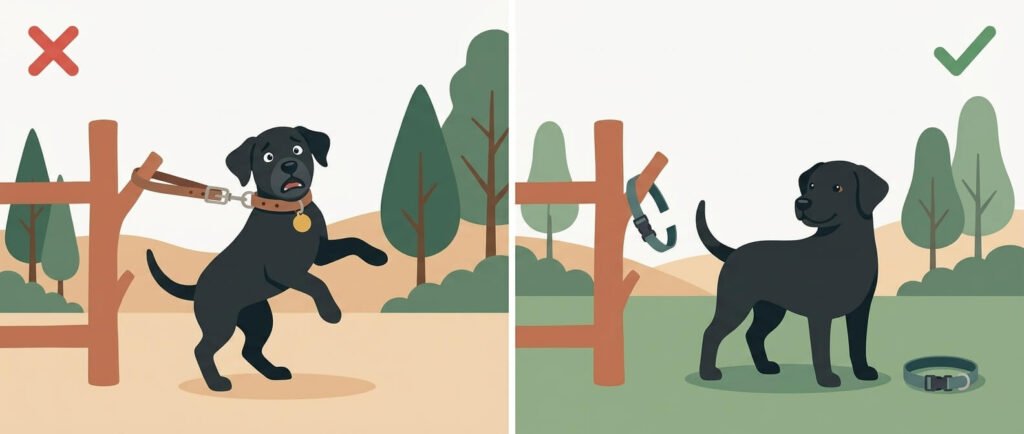
The Risks of Breakaway Collars
The main risk is the collar releasing at the wrong time:
Your dog is found by a Good Samaritan, but there are no ID tags because the collar came off
Your dog slips out of the collar during a walk because too much force was applied
Your dog gets lost, and the collar with the GPS tracker comes off
What it looks like: A breakaway collar can leave your dog without identification or leash attachment in a moment when they need it most.
Quick answer: A breakaway collar is designed to snap open under pressure—preventing strangulation if your dog gets caught on a fence, branch, or another dog’s jaw. It’s the best choice for dogs who spend time unsupervised outdoors, wear a collar 24/7, jump fences, or live in multi-dog households. But it has a real risk: the collar can release at the wrong moment, leaving your dog without ID tags or leash attachment when they need it most. The breakaway collar vs flat collar for dogs decision comes down to which risk is bigger for your dog.
Part 3
Head-to-Head Comparison: Breakaway vs Flat Collar
Here's how the two collar types stack up side by side—the clearest way to see the breakaway collar vs flat collar for dogs difference.
Feature | Flat Collar | Breakaway Collar |
|---|---|---|
Stays on under normal use | ✅ Yes | ✅ Yes |
Won't release under leash pulling | ✅ Yes | ⚠️ Usually, but not guaranteed |
Prevents strangulation if caught | ❌ No | ✅ Yes |
Secure for ID tags | ✅ Yes | ✅ Yes (when on) |
Risk of collar coming off | Very low | Higher |
Safe for unsupervised wear | ⚠️ Risk of choking | ✅ Yes |
Safe for leash walking | ✅ Yes | ⚠️ Risk of release |
Recommended for 24/7 wear | ⚠️ Moderate risk | ✅ Yes |
Recommended for walks/training | ✅ Yes | ⚠️ Not recommended |
Quick answer: The breakaway collar vs flat collar for dogs comparison comes down to a simple trade-off. A flat collar stays on under all conditions—secure for leash walking and ID tags—but it won’t release if caught, creating a choking risk. A breakaway collar releases under pressure—preventing strangulation—but it can also release at the wrong moment, leaving your dog without ID or leash attachment. Neither is universally better. The right choice depends on your dog’s lifestyle and risk profile.
Part 4
The Choking vs. Escaping Trade-Off: The Core Tension
This is the core tension. You're choosing between two very different risks. That's the heart of the breakaway collar vs flat collar for dogs decision.
-
Flat collar: Higher risk of strangulation, lower risk of losing ID
-
Breakaway collar: Lower risk of strangulation, higher risk of losing ID
Quantifying the Risks
The exact statistics on collar-related accidents are hard to come by, but here’s what we know:
Vets and shelters regularly see cases of collar injuries—strangulation, wounds, and jaw entrapment.
Most flat collar accidents happen when dogs are unsupervised—in yards, crates, or during play.
Breakaway collar failures happen when the collar is stressed beyond its threshold—which can happen during walks if a strong dog pulls hard.
How to Decide
Think about your dog’s daily life and answer these questions:
Question | If Yes → |
|---|---|
Does your dog wear a collar 24/7? | Consider a breakaway collar |
Is your dog left alone in a yard or crate? | Consider a breakaway collar |
Does your dog jump fences or explore tight spaces? | Consider a breakaway collar |
Do you have multiple dogs who play roughly? | Consider a breakaway collar |
Do you go on leashed walks in busy areas? | Use a flat collar for walks |
Is losing ID tags a major concern? | Use a flat collar for walks |
The answer is often “both” — used in different situations.
Quick answer: The breakaway collar vs flat collar for dogs trade-off is simple: flat collars have a higher risk of strangulation but a lower risk of losing ID; breakaway collars have a lower risk of strangulation but a higher risk of losing ID. To decide, ask yourself: does your dog wear a collar 24/7? Is your dog left alone in a yard or crate? Does your dog jump fences or play rough with other dogs? If yes to any, consider a breakaway collar. For leashed walks in busy areas, a flat collar is usually safer. Most owners end up using both—in different situations.
Part 5
Collar Materials and Durability: What Lasts and What Fails
Not all collars are created equal. The material matters for both safety and longevity. It's a factor most owners overlook in the breakaway collar vs flat collar for dogs debate.
Nylon
Pros: Affordable, lightweight, comes in many colors and patterns
Cons: Can fray over time, holds odors, can cause “collar rash” (contact dermatitis) in some dogs
Durability: 1–3 years with regular use
Leather
Pros: Strong, durable, looks great, softens with age
Cons: Requires conditioning, can rot if soaked repeatedly, more expensive
Durability: 5–10+ years with proper care
Biothane / Coated Nylon
Pros: Waterproof, easy to clean, very strong, odor-resistant
Cons: Less breathable, less flexible
Durability: 3–5 years
Material Safety Checklist
Material | Best For | Not Recommended For |
|---|---|---|
Nylon | Everyday use, budget-friendly | Dogs with sensitive skin |
Leather | Long-term durability | Dogs who swim frequently |
Biothane | Water activities, muddy environments | Supervised indoor-only dogs |
One more note: Check your collar regularly for signs of wear—fraying, cracking, stretching, or rust on hardware. A worn collar is a weak point, regardless of the material.
Quick answer: For the breakaway collar vs flat collar for dogs decision, material matters too. Nylon is affordable and lightweight but frays and holds odors (1–3 years). Leather is strong and durable but needs care and can rot when wet (5–10+ years). Biothane (coated nylon) is waterproof, odor-resistant, and easy to clean (3–5 years). Check your collar regularly for wear—fraying, cracking, stretching, or rust. A worn collar is a weak point, regardless of the material.
Part 6
The Two-Collar Strategy: How to Use Both Safely
The best solution for many dogs is to use both types—just at different times. It's the practical answer to the breakaway collar vs flat collar for dogs question.
How It Works
Breakaway collar for 24/7 wear:
Kept on at all times for ID tags
Breaks away if caught during unsupervised play
Low risk of strangulation during yard time or crate time
Flat collar for walks and outings:
Put on just before leaving the house
Provides secure leash attachment
Removed and replaced with the breakaway when you return
Step-by-Step Routine
Morning: Dog wears breakaway collar with ID tags (always).
Before a walk: Remove breakaway, attach flat collar with leash.
During the walk: Leash attached to flat collar.
After the walk: Remove flat collar, put breakaway back on.
Night: Dog wears breakaway collar (or goes collar-free if safe).
Where to Keep the Collars
Hang both collars by the door with the leashes.
Keep a spare flat collar in your car.
If you use a GPS tracker, consider a harness for walks and keep the tracker on the breakaway collar for everyday wea
Quick answer: The best solution for the breakaway collar vs flat collar for dogs question is often to use both. Keep a breakaway collar on your dog 24/7 (for ID and safety during unsupervised time), and switch to a flat collar for walks and outings (for secure leash attachment). Hang both collars by the door with the leashes so the routine is easy. If you use a GPS tracker, consider a harness for walks and keep the tracker on the breakaway collar for everyday wear.
Part 7
Special Considerations: Puppies, Small Breeds, and Multi-Dog Homes
Not all dogs are the same. Here are some special cases to think about. These are the edge cases in the breakaway collar vs flat collar for dogs decision.
Puppies
Puppies grow fast. A collar that fits today may be too loose in a month.
Check fit every week.
Use a breakaway collar for unsupervised wear.
Don’t leave a flat collar on a puppy in a crate.
Small Breeds
Small dogs have more delicate necks and can be injured by standard-sized collars.
Look for collars specifically designed for small breeds.
Lighter materials (thin nylon) are better.
Breakaway collars are a good choice for 24/7 wear.
Multi-Dog Homes
Dogs playing together can get their jaws caught in each other’s collars.
Breakaway collars reduce this risk.
Remove collars during supervised play if possible.
Don’t leave multiple dogs alone together with flat collars on.
Dogs with a History of Escaping
If your dog is an escape artist, you need a different approach.
Use a flat collar or harness for walks.
Consider a GPS tracker on a flat collar.
Don’t rely on a breakaway collar for containment.
Quick answer: A few dogs need special consideration in the breakaway collar vs flat collar for dogs decision. Puppies grow fast—check collar fit weekly and use a breakaway collar for unsupervised wear. Small breeds have delicate necks—choose lighter materials and small-breed-specific collars. Multi-dog homes face jaw entrapment risk—breakaway collars reduce it, and you should remove collars during supervised play. Dogs with a history of escaping need a flat collar or harness for walks, plus a GPS tracker—don’t rely on a breakaway collar for containment.
References & Further Reading
The information in this guide is based on research and insights from the following sources:
American Veterinary Medical Association (AVMA) — General pet safety recommendations
American Kennel Club (AKC) — Collar fitting and safety guidelines
Pet Professional Guild — Collar safety and training best practices
Humane Society of the United States — Collar and tag safety guidelines
Veterinary industry consensus — Collar injury prevention and multi-dog household safety recommendations
Disclaimer: I’m a dog owner, not a veterinarian or a professional dog trainer. This content is for informational purposes only and does not replace professional veterinary or training advice. For any concerns about your specific dog—especially collar-related injuries—please consult a licensed veterinarian.
FAQ: Breakaway Collar vs Flat Collar for Dogs
A flat collar is a continuous band of material with a buckle or snap closure—it stays on under all conditions. A breakaway collar has a special clasp designed to release under pressure, preventing strangulation if the collar catches on something. The difference matters most in two situations: unsupervised wear (where a flat collar can be a choking risk) and leashed walks (where a breakaway collar can release unexpectedly).
It depends on your dog's lifestyle and risk profile. A breakaway collar is safer for dogs who wear a collar 24/7, spend time unsupervised outdoors, or live in multi-dog households. A flat collar is safer for leashed walks, training, and situations where a secure leash attachment matters most. Neither is universally better—most owners use both.
Not recommended. A breakaway collar can release under pressure, which means it can slip off if your dog pulls hard or lunges. For walks, use a flat collar or a harness. Reserve the breakaway collar for unsupervised wear and ID tags.
No—this is one of the most dangerous scenarios. A flat collar can catch on the crate door or bars and choke your dog. If your dog is crated, either remove the collar entirely or use a breakaway collar.
You should be able to fit two fingers between the collar and your dog's neck—but not pull it over their head. If the collar is too loose, it can slip off. If it's too tight, it can cause skin irritation or discomfort.
For most dogs, yes. Use a breakaway collar for 24/7 wear (ID tags, unsupervised time) and a flat collar for walks and outings (secure leash attachment). This two-collar strategy covers both risks.
It depends on your dog. Nylon is affordable and lightweight but frays and holds odors (1–3 years). Leather is strong and durable but needs care and can rot when wet (5–10+ years). Biothane (coated nylon) is waterproof, odor-resistant, and easy to clean (3–5 years). For dogs with sensitive skin, biothane or soft leather is usually best.
Check your collar monthly for signs of wear—fraying, cracking, stretching, or rust on hardware. Replace nylon collars every 1–3 years, leather every 5–10+ years (with proper care), and biothane every 3–5 years. A worn collar is a weak point, regardless of the material.
Use a flat collar or a harness for walks, and consider a GPS tracker on a flat collar for real-time location. Don't rely on a breakaway collar for containment—it can release at the wrong moment. For escape-prone dogs, a well-fitted harness is often the most secure option.
Harnesses are a great alternative for walks—especially for dogs who pull, have delicate necks, or are escape artists. A harness distributes pressure across the chest instead of the neck. But harnesses aren't a substitute for ID tags: keep a breakaway collar on your dog for identification, and use a harness for walks.
Collar Safety Checklist
□ Can you slip two fingers comfortably between the collar and your dog's neck?
□ Can the collar be pulled over your dog's head? (If yes, it's too loose)
□ Is the collar too tight? (You should be able to slip fingers under it)
□ No fraying, cracking, or stretching of the material
□ Buckles and clips are in good working condition
□ No rust or weakness in D-rings or hardware
□ Flat collar for walks and outings
□ Breakaway collar for unsupervised wear
□ Remove collars during supervised indoor play
☐ Test the release mechanism to know how much pressure is required.
☐ Check the release mechanism for wear.
☐ Replace the collar every 6–12 months.
□ Never leave your dog unsupervised in a flat collar
□ Never crate your dog with a flat collar on
□ Never leave multiple dogs together with flat collars
The bottom line: This checklist takes 2 minutes a week. It can prevent a choking accident—and keep your dog’s ID secure.
A Final Thought
Every collar comes with trade-offs.
Flat collars: Secure, but can choke if caught.
Breakaway collars: Prevent choking, but can release and leave your dog without ID.
The best approach? Use both.
Breakaway for 24/7 wear
Flat for walks and outings
Check fit regularly. Inspect for wear. Switch based on the situation.
That extra effort could save your dog’s life. That’s the bottom line of the breakaway collar vs flat collar for dogs decision.
More in This Series
This article is part of our Lost Dog Prevention series. Explore the other guides below.
Lost Dog Prevention: The Complete Guide to Microchips, ID Tags, and GPS Trackers — Start with the complete guide, then dive into each layer in detail.
Dog Microchip vs GPS Tracker: Which One Does Your Pup Need? — A head-to-head comparison to help you choose.
What to Do If Your Dog Gets Lost: Step-by-Step Emergency Plan — Your action plan for the first hour and beyond.
How to Train a Dog Recall: The Most Important Safety Command — Practical steps to build a recall you can count on.
All part of the Lost Dog Prevention module here on OutdoorDogSafety.com.
Disclaimer: This content is for informational purposes only and does not constitute veterinary or professional safety advice. Always consult with a qualified veterinarian or professional dog trainer regarding your dog’s specific needs and safety considerations.