
Dog Microchip vs GPS Tracker:
Which One Does Your Pup Need?
Two very different technologies. One clear answer: you need both — here's why.
You’ve probably heard this question from fellow dog owners—or maybe you’ve asked it yourself: “Should I get my dog microchipped, or should I buy a GPS tracker instead?”
It’s a common debate: dog microchip vs GPS tracker—which one is right for your pup? It sounds like a reasonable choice. Both help with lost dogs. Both give you peace of mind. Why pay for both if one will do?
Here’s the short answer: they do completely different jobs, and choosing one over the other leaves a dangerous gap in your dog’s safety.
Think of it this way: a microchip is your dog’s permanent ID card—it proves who they belong to, but only after someone finds them. A GPS tracker is your search party—it helps you find them before someone else does.
According to a survey by the American Veterinary Medical Association (AVMA), microchipped dogs are returned to their owners at more than double the rate of dogs without chips. But that number only tells part of the story. The other part? GPS trackers help owners locate their dogs during the critical first hours of a disappearance—often before a microchip even comes into play.
So when you’re weighing the dog microchip vs GPS tracker decision, the real question isn’t which one is “better.” It’s which one solves which problem—and whether you can afford to go without either.
I’m not a veterinarian or a tech expert. I’m just someone who has spent time talking to veterinarians, reading case reports, and learning the ins and outs of both technologies—so you don’t have to figure this out the hard way.
This guide breaks down exactly what microchips and GPS trackers can and cannot do, compares their costs and limitations, and helps you decide what combination works best for your dog.
What's in This Guide
In this guide, I’ll walk you through:
-
What a microchip actually does — and what it doesn’t
-
What a GPS tracker actually does — and what it doesn’t
-
A head-to-head comparison — cost, coverage, reliability, and limitations
-
Why you need both — and how they work together
-
Which one to get first — if you can only choose one right now
-
A decision checklist — for your specific dog and lifestyle
The bottom line: This isn’t a “which one is better” question. It’s a “which one does what” question—and the answer is both.
Part 1
The Microchip: Permanent ID (Not a Tracker)
Let's clear up the biggest misconception right away: a microchip cannot track your dog.
I've heard people ask, "Can I track my runaway dog with a dog tracker chip?" The answer is no. And this misunderstanding is more common than you'd think—even veterinarians report that pet owners sit across from them every week believing their microchip can track their animal.
What a Microchip Actually Is
A microchip is a tiny radio-frequency identification (RFID) transponder about the size of a grain of rice—roughly 11–14 mm long and 2–2.3 mm thick, weighing about 0.025 grams. It’s enclosed in biocompatible glass and implanted under your dog’s skin, typically between the shoulder blades, in a procedure that takes about 10 seconds and causes minimal discomfort—similar to a routine vaccination.
The chip itself has no battery, no moving parts, and no ability to transmit location data. It’s a passive device that sits dormant under your dog’s skin until activated by a special scanner.
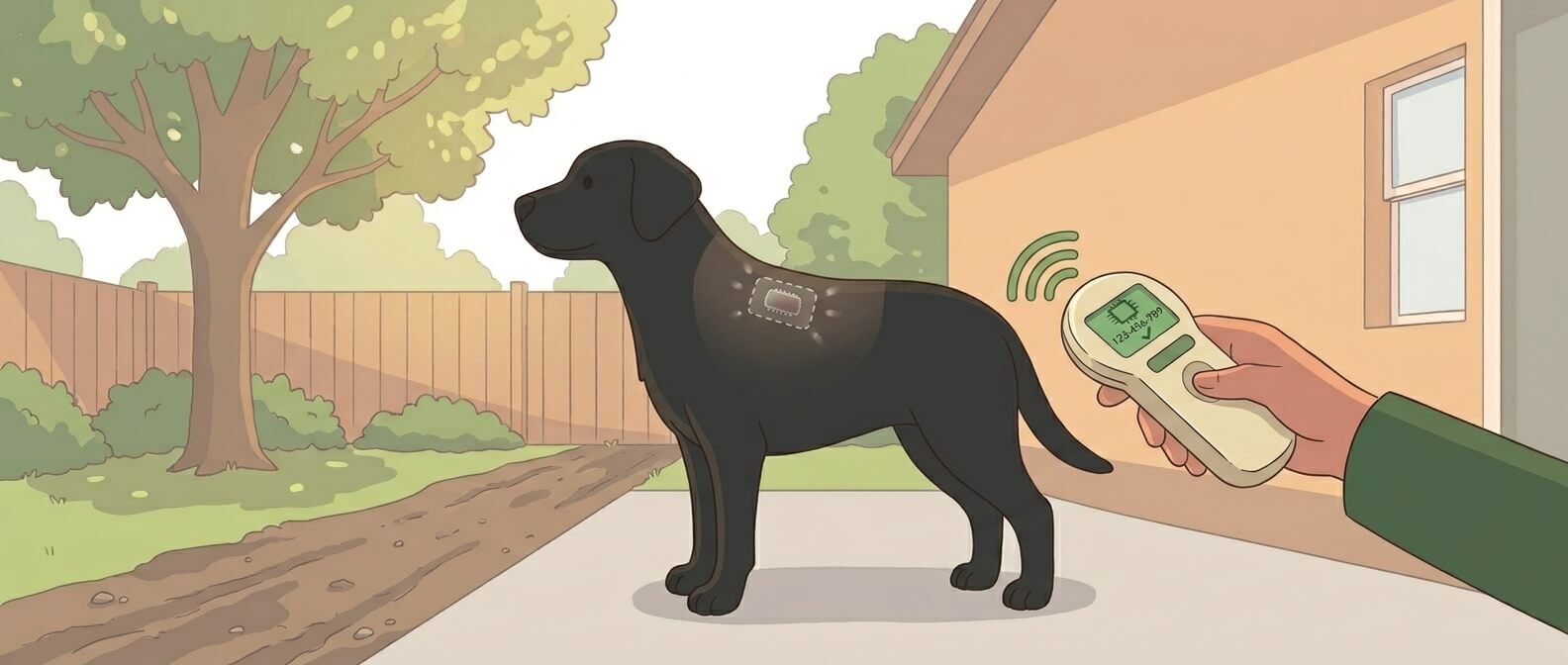
How It Actually Works
Here’s what happens when a lost dog is found and taken to a vet or shelter:
-
A staff member passes a scanner over the dog’s body.
-
The scanner emits low-frequency radio waves.
-
These waves activate the microchip, which transmits its unique identification number back to the scanner.
-
The ID number is entered into a database to retrieve the owner’s contact information.
-
The owner is contacted and reunited with their dog.
Critical detail: The scanning range is only 2–4 inches from the scanner. Someone has to physically find your dog, bring them to a place with a scanner, and actually scan them—and the chip only works if your registration information is current.
What Microchips Do Well
-
Permanent identification that can’t be lost, removed, or chewed up like a collar tag
-
Lifetime operation—no batteries to charge or replace
-
Works internationally with ISO-standard chips (134.2 kHz)
-
Proven effectiveness—microchipped dogs are returned at 52% compared to just 22% for dogs without chips
What Microchips Cannot Do
-
Real-time tracking—they don’t transmit location data or connect to satellites or cellular networks
-
Help you during an active search—they only come into play after someone else finds your dog
-
Alert you if your dog wanders—no geofencing, no escape alerts
-
Work without a scanner—a Good Samaritan must know to get the dog scanned
The #1 Failure Point: Registration
Here’s the part that matters most—and the part most owners get wrong.
“A microchip that isn’t registered, or that has outdated contact details on file, is all but useless.”
The most common reason microchipped animals are not returned to their owners is incorrect or disconnected contact information in the registry.
The chip is the lock. Registration is the key.
You could spend $15–$50 (in the U.S.) on the procedure, but if you move and forget to update your phone number, that chip might as well not exist. Set a calendar reminder to verify your microchip registration annually—ideally at your dog’s annual wellness exam.
For more on microchipping, see the AVMA’s microchipping page.
Quick Answer:
A microchip is not a GPS tracker. It’s a passive RFID chip—about the size of a grain of rice—that sits under your dog’s skin and stores a unique ID number. It only works when someone finds your dog, takes them to a vet or shelter, and has them scanned. The chip has no battery and can’t transmit location data. The biggest failure point? Registration. If your contact info isn’t current, the chip might as well not exist.
Part 2
The GPS Tracker: Real-Time Location Monitoring
If a microchip is your dog's permanent ID card, a GPS tracker is your search party. It helps you find your dog before someone else does—often within minutes of them wandering off.
What a GPS Tracker Actually Is
Unlike a microchip, a GPS tracker is an active device worn on your dog’s collar. It uses:
-
GPS satellites to determine your dog’s precise location
-
Cellular networks (typically 4G/LTE) to transmit that location to your phone
-
Bluetooth for close-range finding when you’re nearby
Most GPS dog trackers are significantly larger than microchips — about the size of a small key fob or larger — but they’re designed to be comfortable for your dog to wear.
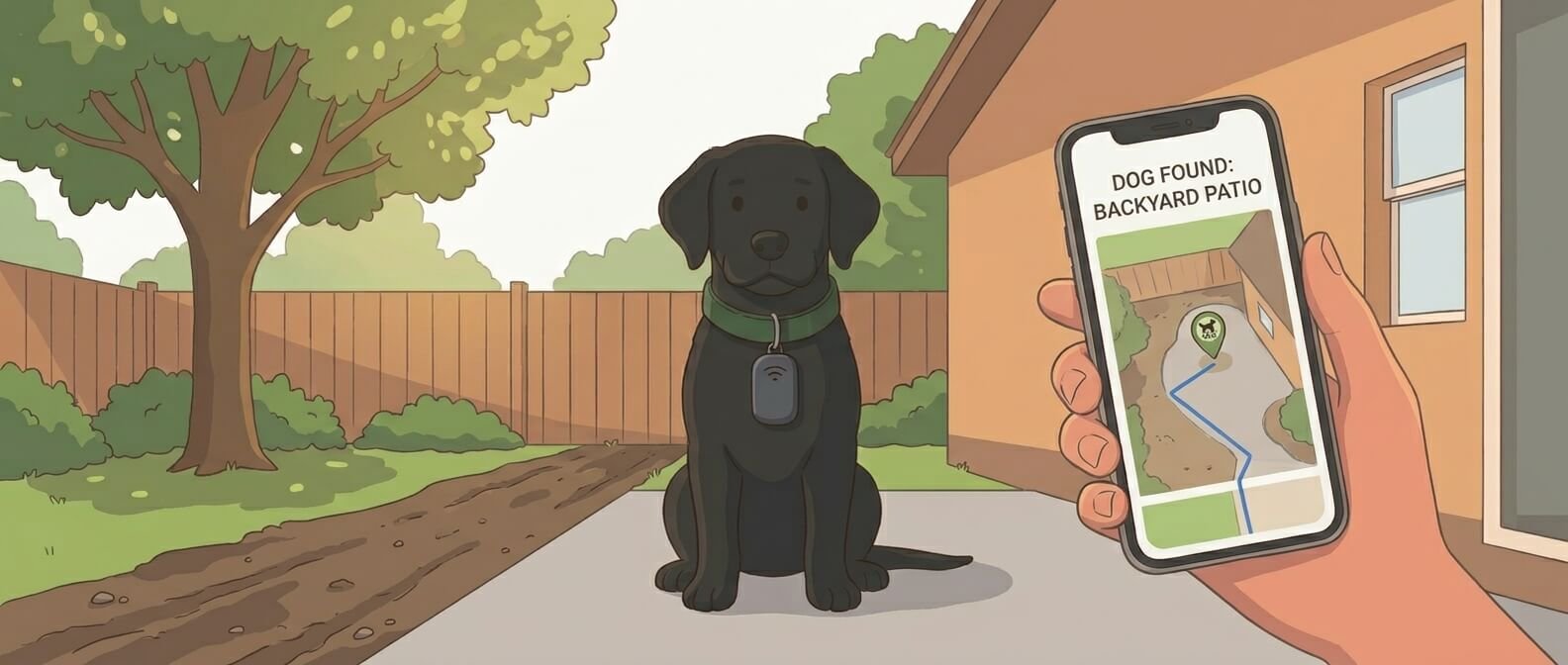
How It Actually Works
-
The tracker on your dog’s collar gets a satellite fix on its location.
-
It transmits that location data via cellular network to an app on your phone.
-
You can see your dog’s location on a map in real-time.
-
You can set virtual fences (geofences) and get alerts the moment your dog leaves a safe zone.
What GPS Trackers Do Well
-
Real-time location tracking—you can see exactly where your dog is, anywhere with cellular coverage
-
Instant escape alerts—geofence notifications mean you know immediately if your dog wanders
-
Active search capability—helps you find your dog during the critical first hours
-
Activity and health monitoring—many trackers also track steps, sleep, and behavior trends
What GPS Trackers Cannot Do
-
Serve as permanent ID—they can fall off, be removed, or run out of battery
-
Work without cellular coverage—no signal, no tracking
-
Operate without charging—most require charging every 2–7 days in active tracking mode
-
Work indefinitely—devices degrade, and subscriptions expire
The Battery Reality
Battery life is arguably the single most important spec for a GPS tracker. If the battery dies, so does your ability to find your dog.
Tracker Type | Normal Standby Battery | "Lost Dog" (Live) Mode |
|---|---|---|
Tractive DOG 6 | ~14 days | 2-7 days (Live mode drains fast) |
Fi Smart Collar | Several weeks to months | 1-2 days in Live mode |
Halo (containment collar) | ~20 hours | Varies |
The range is enormous. Larger trackers generally pack bigger batteries, so bigger dogs can often carry a longer-lasting device. If you own a skittish dog that could take days or weeks to recover once lost, prioritize battery life above almost everything else.
For a broader look at GPS dog trackers, see the AKC’s guide to GPS dog trackers.
Quick Answer: A GPS tracker is an active device worn on your dog’s collar. It uses GPS satellites, cellular networks, and Bluetooth to show your dog’s real-time location on your phone—plus escape alerts and virtual fences. But GPS trackers aren’t perfect: they can fall off, run out of battery, or lose signal in areas without coverage. Battery life is the single most important spec. If your dog goes missing for days, you want a tracker that lasts.
Part 3
Head-to-Head Comparison
Here's a side-by-side look at what each technology actually does—the clearest way to see the dog microchip vs GPS tracker difference.
Feature | Microchip | GPS Tracker |
|---|---|---|
Real-time location tracking | ❌ No | ✅ Yes, anywhere with cellular coverage |
Alerts when dog leaves safe zone | ❌ No | ✅ Yes (geofence) |
Helps during active search | ❌ No | ✅ Yes |
Works after someone finds dog | ✅ Yes (if scanned) | ❌ No (can be lost or removed) |
Permanent, can't be lost | ✅ Yes | ❌ No (collar can come off) |
Battery/charging required | ❌ No (lifetime) | ✅ Yes (regular charging) |
Requires subscription | ❌ No (one-time fee) | ✅ Yes ($5–$20/month) |
Scan required | ✅ Yes (vet/shelter) | ❌ No (app on your phone) |
Works in rural areas | ✅ Yes (if scanned) | ⚠️ Depends on cellular coverage |
Works internationally | ✅ Yes (ISO standard) | ⚠️ Depends on carrier |
Quick Answer: The clearest way to see the dog microchip vs GPS tracker difference is this: a microchip is permanent but passive (no battery, no tracking—only works when scanned). A GPS tracker is active but temporary (real-time location, but needs charging and a subscription). They solve completely different problems—which is why you need both.
Part 4
The Cost Reality
Let's talk money. The cost difference between a microchip and a GPS tracker isn't just about the upfront price tag—it's about ongoing expenses that add up over your dog's lifetime. Here's what you're actually looking at. Cost is one of the biggest deciding factors in the dog microchip vs GPS tracker choice.
Microchip Costs (prices in the U.S.)
A microchip is a one-and-done expense. You pay for the procedure and the registration once, and that’s it for the rest of your dog’s life.
-
Procedure: $15–$50 (includes chip and implantation) at a veterinary clinic
-
Adoption/shelter: Often included in adoption fees or offered at reduced cost ($10–$20)
-
Registration: May be included or require a separate fee of $15–$25
-
Lifetime cost: $15–$75 total (one-time), then $0 ongoing
GPS Tracker Costs (prices in the U.S.)
A GPS tracker is a different financial commitment. The device is just the beginning—the real cost is the monthly subscription that keeps it connected to cellular networks.
-
Device: $30–$200 depending on brand and features
-
Subscription: $5–$20/month for cellular service
-
Replacement/Upgrades: Every 2–3 years as devices degrade or batteries weaken
-
Lifetime cost over 15 years: $1,500–$4,000+ per pet
Bottom line: Microchipping is one of the least expensive and most consequential things you can do for your dog’s safety. GPS tracking is a significant ongoing investment—but for many owners, it’s worth the peace of mind.
For more on microchip and GPS costs, see the Humane Society’s lost pet resources.
Quick Answer: When weighing the dog microchip vs GPS tracker decision, cost is one of the biggest factors. A microchip is a one-time cost ($15–$75 total, then $0 ongoing). A GPS tracker is an ongoing investment ($30–$200 for the device, plus $5–$20/month for the subscription—$1,500–$4,000+ over 15 years). They’re not competitors—they’re complementary. A microchip is the cheapest safety investment you can make. A GPS tracker is worth it if your dog has a high risk of getting lost.
Part 5
Which One Does Your Dog Actually Need?
Here's the honest answer: every dog needs a microchip. Not every dog needs a GPS tracker. That's the core of the dog microchip vs GPS tracker decision.
Every Dog Needs a Microchip
The AVMA, AKC, and every major veterinary organization recommend microchipping for all dogs. It’s permanent, one-time, low-cost identification that can’t be lost. Many countries and some U.S. states require it.
If you do nothing else on this list, microchip your dog and keep the registration updated.
GPS Trackers Are Situational
A GPS tracker provides the most value for:
-
Dogs with a history of escaping—they give you an early warning and a direct line to their location
-
Dogs who spend time off-leash—hiking, camping, or rural life where a lost dog can travel miles quickly
-
Skittish or noise-sensitive dogs—dogs that bolt during thunderstorms or fireworks are at high risk
-
Active outdoor families—if you frequently camp, hike, or travel with your dog, a GPS tracker adds a crucial layer
-
Senior dogs with cognitive decline—disoriented dogs can wander and struggle to find their way home
A GPS tracker may be overkill for:
-
A homebody dog who only goes on leashed walks in the neighborhood
-
A small breed where collar weight and tracker size are concerns
-
Owners who can’t justify the ongoing subscription cost
Quick Answer: For the dog microchip vs GPS tracker question, the answer is: every dog needs a microchip—it’s permanent, one-time, low-cost identification that can’t be lost. But not every dog needs a GPS tracker. GPS trackers are most valuable for dogs that escape often, spend time off-leash, are skittish or noise-sensitive, live in active outdoor families, or are seniors with cognitive decline. For a homebody dog who only goes on leashed walks, a GPS tracker may be overkill.
Part 6
The Expert Consensus: Why You Need Both
Let me be direct: microchips and GPS trackers are not alternatives. They are complementary. That's the conclusion of every dog microchip vs GPS tracker debate.
The experts agree across the board (paraphrased from veterinary and pet-industry sources):
“Ideally, it’s smart to have both [a GPS tracker and microchip], if possible. The GPS helps you find a lost pet immediately, and the microchip serves as backup for permanent identification.”
“Think of the two as partners, not substitutes. Experts consistently recommend using a GPS tracker alongside a permanent microchip, never instead of one. The chip is your safety net; the tracker is your search party.”
“A microchip relies on a chain of events going right: the pet being found, brought to your facility or clinic, scanned before reunited. A GPS tracker puts the owner in control to locate their pet before they go missing. However, a GPS Tracker alone can run out of battery or be removed. Together, there’s no gap.”
The Scenario That Makes It Clear
Your dog bolts during a thunderstorm.
-
GPS tracker: You’re immediately alerted. You open the app and see they’re two blocks away. You head straight there. Reunited in 15 minutes.
-
Microchip: You have no idea where they are. You search for hours. Three days later, a neighbor finally catches them and takes them to a shelter. The vet scans the chip, calls you, and you’re reunited—three days later.
Now imagine the same scenario, but:
-
No GPS tracker: You don’t know where they are. You spend hours searching.
-
Microchip: The neighbor takes them to a shelter. The chip is scanned, and they call you. Reunited—but only because the dog was found and brought somewhere.
The best protection uses both. The GPS tracker helps you find them during the search. The microchip is the backup if the tracker fails, the collar comes off, or the dog travels farther than you can cover.
Quick Answer: The dog microchip vs GPS tracker debate ends with the same answer: you need both. A GPS tracker helps you find your dog during an active search (real-time location). A microchip is the backup if the tracker fails, the collar comes off, or the dog travels farther than you can cover. In every expert scenario, using both gives the best outcome.
FAQ: Lost Dog Prevention
No. Microchips do not have GPS or location-tracking capability. They only provide identification after someone finds your dog and scans the chip. That's why the dog microchip vs GPS tracker comparison matters—they do completely different jobs. A microchip is permanent ID; a GPS tracker is real-time location. You need both.
Not necessarily—but it depends on your dog's risk level. If your dog has a history of escaping, spends time off-leash, is skittish or noise-sensitive, or if you hike and camp in remote areas, a GPS tracker is a strong investment. If your dog is a homebody who only goes on leashed neighborhood walks, a microchip + ID tag may be enough.
Microchip is dramatically cheaper. A microchip costs $15–$75 one-time, with no ongoing fees. A GPS tracker costs $30–$200 for the device, plus $5–$20/month for the subscription—$1,500–$4,000+ over 15 years. But they're not competitors. A microchip is the cheapest safety investment you can make; a GPS tracker is worth it if your dog has a high risk of getting lost.
No. AirTags rely on nearby Apple devices to report their location, so they may not update for hours in rural areas or on hiking trails. They're a helpful backup, but not a real-time GPS tracker. For live tracking and escape alerts, use a dedicated GPS tracker.
Not updating the registration. A microchip only works if the contact information on file is current. If you move or change phone numbers, the chip might as well not exist. Set a calendar reminder to verify your registration annually—ideally at your dog's annual wellness exam.
Most GPS trackers need charging every 2–7 days in active tracking mode, and every 1–2 weeks in standby mode. Battery life varies widely by brand: Tractive DOG 6 lasts ~14 days standby or 2–7 days in Live mode; Fi Smart Collar lasts several weeks to months in standby, but only 1–2 days in Live mode.
It depends on cellular coverage. GPS trackers use cellular networks to transmit location data, so if there's no signal, there's no tracking. In remote areas, a GPS tracker may not update for hours or at all. If you hike or camp in remote areas, choose a tracker with multi-network coverage (like Tractive) and check the coverage map before you go.
A microchip lasts your dog's entire lifetime. It has no battery, no moving parts, and doesn't need replacement. The only thing that needs to be updated is your registration information.
References & Further Reading
The information in this guide is based on research and insights from the following sources:
-
American Veterinary Medical Association (AVMA) — Microchipping FAQ, pet ownership statistics, and Lost Pet Survey
-
AKC Reunite — Microchip registration and pet recovery data
-
Best Friends Animal Society — Expert commentary on GPS trackers vs. microchips
-
ASPCA Animal Poison Control Center — Emergency contact and poison prevention resources (U.S.: (888) 426-4435)
-
Tractive — GPS tracker battery life and coverage specifications
-
Fi Smart Collar — GPS tracker battery and feature specifications
-
Apple — AirTag intended use guidelines (items, not pets)
-
Veterinary industry consensus — Microchipping as standard of care for all dogs
Disclaimer: I’m a dog owner, not a veterinarian or a tech expert. This content is for informational purposes only and does not replace professional veterinary advice. For any concerns about your specific dog, please consult a licensed veterinarian.
A Final Thought
Microchips and GPS trackers are not competing technologies. They solve two completely different problems. That’s the whole answer to the dog microchip vs GPS tracker question.
-
Microchips solve the identification problem—proving who your dog belongs to when they’re found.
-
GPS trackers solve the location problem—helping you find your dog when they’re lost.
One gives you a permanent safety net. The other gives you a search party.
Use both. Your dog is counting on you. That’s what lost dog prevention really comes down to.
More in This Series
This article is part of our Lost Dog Prevention series. Explore the other guides below.
Lost Dog Prevention: The Complete Guide to Microchips, ID Tags, and GPS Trackers — Start with the complete guide, then dive into each layer in detail.
What to Do If Your Dog Gets Lost: Step-by-Step Emergency Plan — Your action plan for the first hour and beyond.
Breakaway Collar vs Flat Collar for Dogs: Safety Trade-Offs Explained — Which collar is right for your dog’s lifestyle?
How to Train a Dog Recall: The Most Important Safety Command — Practical steps to build a recall you can count on.
All part of the Lost Dog Prevention module here on OutdoorDogSafety.com.
Disclaimer: This content is for informational purposes only and does not constitute veterinary or professional safety advice. Always consult with a qualified veterinarian or professional dog trainer regarding your dog’s specific needs and safety considerations.